


Noises and Vibrations in Gear Drives
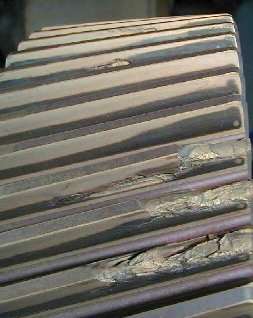 Gear drives do not perfectly transmit forces linearly. Although torque transmission is slip-free, there is a minimal speed fluctuation (torsional pulsation) with each tooth engagement, leading to pulsation in force transmission. Even with intact gears, pulsating forces are generated - resulting in "common" noises and vibrations - and are amplified with damaged gears, causing various vibrations. The strength of the pulsating forces mentioned in the introduction depends on various factors such as load, type of gearing (straight or helical), tooth surface properties (roughness, wear, breakouts), and tooth design (involute gearing, hybrid gearing, etc.). When determining the condition of drives and gears, construction parameters (gearing type and design) and operating conditions (load) are often considered given, so investigations usually focus on the surface properties of the teeth. Causal relationships detailed below can be used for this purpose.
Impact Impulses Due to Tooth Contact
When two teeth come into contact, the so-called tooth contact impact occurs. This natural force effect occurs with each tooth contact. Its strength depends on the magnitude of the load, the tooth overlap in helical gearing, and the tooth shape itself. With intact gears, nearly pure sinusoidal excitation occurs, appearing as the tooth contact frequency in the spectrum. The tooth contact frequency, often referred to as the gear mesh frequency in English, can be calculated based on the following equation:
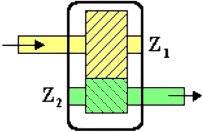
Figure: Single-stage gear drive [source: PIM]
Ff = n1 / 60 × Z1 = n2 / 60 × Z2, where Ff is the tooth frequency, n1 is the speed of shaft 1, Z1 is the number of teeth on gear 1, n2 is the speed of shaft 2, Z2 is the number of teeth on gear 2. Therefore, the tooth contact frequency corresponds to the number of teeth in contact per second. Vibration at the tooth frequency is a natural (thus unavoidable) characteristic of gear transmissions.
Impact Impulses Due to Damage on Gears
If one or more teeth are damaged, additional impact excitations occur beyond the "natural" tooth frequency when the "rolling over" happens at these defective locations. Since generally more impacts occur per tooth, multiples of the tooth frequency primarily appear, even though sinusoidal force effects are not present. Practically, with minor damage on one or a few teeth, the multiples of the tooth frequency increase.
Tooth Repeat Frequency
In cases where one or more faulty teeth are present on both meshing gears, in addition to the tooth frequency and its harmonics, the tooth repeat frequency also emerges if there is at least one gear pair where significant vibration impulses occur during their contact. The tooth repeat frequency is the product of the greatest common divisor of the tooth frequencies and the number of teeth on the meshing gears, divided by the product of the numbers of teeth on the meshing gears. It should be noted that during gear design, every manufacturer aims to minimize the occurrence of single tooth contact to eliminate uneven wear. This is achieved by having the smallest possible greatest common divisor of the two gear teeth, which corresponds to using prime numbers for the teeth. (The longest lifespan can be expected from gear pairings where the greatest common divisor of the tooth numbers is "1.") 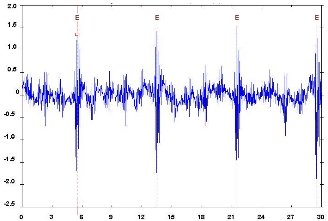
Figure: Impact Impulses from Tooth Repeats [source: DDC]
Torsional Vibrations Due to Breakouts on Gears
Every gear drive exhibits torsional vibrations, manifested in the oscillation of the driven shaft speed. The cause is the non-100% linear force transmission and the gear geometry (shape) error arising from the manufacturing technology (which is always present to a small extent) and the tooth surface roughness. Torsional vibrations are very small in intact gear drives. However, if multiple teeth are damaged, in addition to the impact impulses described earlier and the resulting tooth frequency sidebands, an increase in torsional vibrations is observed. Torsional vibrations result in a change in the tooth frequency, meaning the teeth do not meet at uniform intervals. This phenomenon appears as frequency modulation in the vibration spectrum: the tooth frequency (tooth contact frequency) is modulated ("mixed") with the rotation frequency of the damaged gear. The modulation becomes visible as sidebands at the tooth frequency rotation frequency distance. The frequency spectrum of a gear drive can be schematically represented as follows:
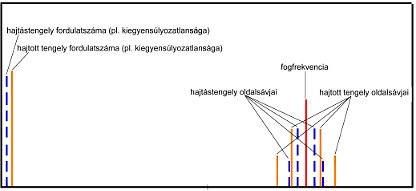
Figure: Schematic Frequency Spectrum of Single-Stage Gear Drive [source: PIM]
Unfortunately, the situation is not as simple in practice: since the gears - as indicated in our example - also transmit force effects resulting from imbalance and misalignment, this also causes torsional vibrations and thus the modulation of the tooth frequency with the rotation frequencies of the two shafts. Therefore, sidebands resulting from torsional vibrations only clearly indicate severe gear faults when the gear drive itself is not subjected to torsional stress.
Fault Diagnosis Based on Vibration Analysis
For single-stage drives, the above frequencies and their sidebands need to be examined. In the case of multi-stage gear drives, the frequencies generated by each stage are calculated in succession: the output rotation frequency of the previous stage corresponds to the input rotation frequency of the next stage. Based on this, the mesh frequency and its modulations can be determined for each stage. (However, the sidebands multiply significantly, as even the last stage is influenced by the mesh frequency and its modulations of the first stage. This means additional modulation of the mesh frequency associated with the last stage - beyond the effects from the input and output sides.) It goes without saying that only with a vibration analyzer of sufficient resolution and frequency bandwidth do we have a chance to discover and separate the mentioned frequencies. The more stages in the drive, the higher resolution (3,200, 6,400, or even 12,800 line spectra) will be required. For spur gears, radial vibrations are sought for straight-toothed transmissions, axial vibrations for helical or herringbone gears, and in both directions for oblique-toothed structures, searching for mesh frequency vibrations and their harmonics, as well as frequency modulations appearing as sidebands. The distance (frequency) of the sidebands characterizes the type and location of the fault: for example, a modulation proportional to the speed of the driving, intermediate, or driven shafts relates to problems with these shafts and the gears on them, a modulation of a different frequency indicates possible speed or load fluctuations, while the frequency modulating the mesh frequencies points to the frequency of gear faults. Sidebands closely grouped around the mesh frequencies mostly indicate faulty gear profiles. Wide (high-frequency) sidebands indicate pulse-like, random impacts or sudden load changes, attributed, for example, to broken teeth. In the case of multiple faults, so-called intermodulation sidebands may arise from the sums or differences of fault modulation frequencies.
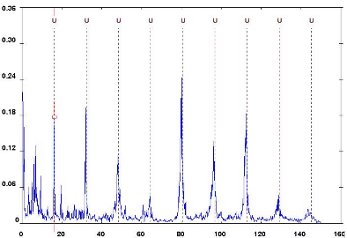
Figure: mesh frequency impulses in case of severe gear damage [source: DDC]
Rahne Eric (PIM Ltd.) pim-kft.hu, gepszakerto.hu
The content of this publication is protected by copyright. Any (even partial) use, electronic or printed re-publication is only permitted with the mention of the source and author's name, and with the author's prior written permission. Violation of copyright (Copyright) will result in legal consequences.
Copyright © PIM Professzionális Ipari Méréstechnika Kft.
2026 | Minden jog fenntartva
Impresszum | Adatkezelés