


In the world of rotating machinery, the most common error is imbalance. It should be noted that imbalance is always present, it just may not reach the threshold to be considered an error. There is no perfectly - "zero" - balanced rotating part, only one that meets our expectations and the requirements of relevant standards.
We speak of imbalance when the weight axis of a given rotating part does not coincide with its axis of rotation. Depending on how these axes relate to each other, the following types of imbalance are distinguished:
Static
In the case of static imbalance, the axis of rotation and the weight axis are parallel.
Opposite
We talk about pair, opposite, or torque imbalance when the axis of rotation and the weight axis intersect at an angle but do not coincide. In the case of dynamic imbalance, the axis of rotation and the weight axis are divergent.
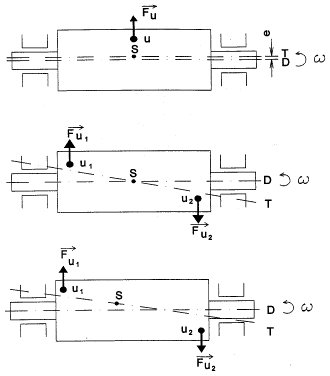
Due to the fact that the center of gravity (or centerline of mass) and the center of rotation (or axis of rotation) do not coincide, a centrifugal force occurs (Figure 4). This force burdens the support of the rotating part: the bearings and structural elements. The resulting centrifugal force naturally rotates around the axis of rotation at the same frequency as the axis itself.
The centrifugal force resulting from imbalance can be calculated based on the following equation: F = m * r * ω2, where F … centrifugal force m … unbalanced mass r … distance of the unbalanced mass from the center of rotation ω … angular velocity (angular frequency) As implied by the equation, the effect of centrifugal force is quadratic with respect to speed, so eliminating imbalance is particularly important for machines operating at higher speeds.
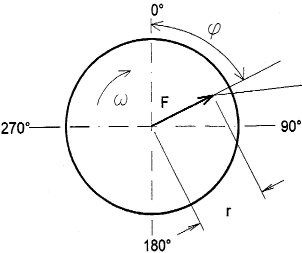
The centrifugal force performs circular motion, so the force acting on a specific point of the bearings or structural elements shows sinusoidal pulsation: during one revolution, it reaches its maximum once and then its minimum. The equation for centrifugal force is:
F(t) = m * r * ω2 * sin(ω*t) The bearings and structural elements must exert an equal and opposite force to keep the rotating part in place. The alternating motion generated in the process - the vibration measured on the bearing housings - also depends on the stiffness of the structural elements. Therefore, the vibration measured on the supports, bearing housings (hereinafter referred to as bearings) is - exclusively in the case of imbalance - proportional to the centrifugal force. Based on this recognition, we can determine the extent of imbalance and perform balancing. This can be done on a balancing machine or on-site, on the machine's own bearings. In this article, we do not discuss balancing on a machine, but on-site balancing - depending on the instrumentation - can be performed using the so-called three-point method or the vector method based on amplitude-phase measurements.
Three-Point Method
This method is used to eliminate imbalance in disc-shaped rotating parts. The procedure is considered the simplest way of balancing, requiring only a manual vibration meter. Satisfactory results can be achieved with five to six runs. The steps of balancing are as follows:
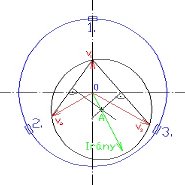
1) Start the machine and measure the radial vibration velocity of the bearing at the operational speed of the rotating part (v0). 2) Determine the required test weight (P), then attach it to any location. 3) Start the machine and measure the vibration velocity (v1). 4) Move the test weight 120º from the previous position and measure the bearing vibration (v2). 5) Move the test weight another 120º. Measure the bearing vibration again (v3). 6) Plot the measured values v1, v2, v3 on a 120º coordinate system in a suitable scale corresponding to the rotation of the rotating part (Figure 3). 7) Construct the center of the circle passing through the endpoints of the vectors (A). Connecting the origin and point A gives the direction of imbalance. Mark this direction on the rotating part. 8) Place the test weight 180º opposite to the direction of imbalance, then perform vibration measurement (v4). 9) The magnitude of imbalance and the mass required for balancing can be calculated from the measured data using the following relationship:

The success of the procedure depends on the fact that the vibrations involved in the calculation mainly stem from imbalance. However, a manual vibration meter is not suitable for determining this, as it measures not the vibration component at the rotational frequency but the broadband level. Therefore, it is preferable to use a frequency analyzer for balancing. The main drawback of the method is that a considerable number of - at least 6 runs including checks - are required to perform the balancing. The large number of starts is often not feasible due to the nature of the machine, and it may take an extremely long time.
Vector (Test Weight-Based) Method
The basis of the procedure is the vibration vector measured in the radial direction of the bearings of the rotating part to be balanced, i.e., the vibration amplitude at the rotation frequency, and its so-called phase. The phase (or phase angle) describes the angular position of the unbalanced weight relative to the point defined on the rotating part (reference marking). This angular position depends on the machine's elasticity and time constant (i.e., the properties that characterize the machine as a mechanical system), as well as on the phase measurement parameters of the used measuring system (measurement principle, application of integration or double integration, signal processing delay, etc.). All these factors are constants for a given machine and measuring system, but can significantly differ from one machine to another and from one instrument to another. At the beginning of a new balancing process, we cannot know where the additional mass causing the unbalance is located. Therefore, we are forced to introduce a change in the system with a mass placed at a known magnitude and known angular position, and thus determine the machine's reaction to unbalance and its sensitivity. As an example, we now present a single-plane balancing: The vibration vector measured after the intervention (red) is the sum of the original R vibration vector (black) and the test mass T effect vector (green). The original vector and the effect vector can be used to determine the magnitude of the original unbalance, i.e., the required correction mass. The angle enclosed by the original and effect vectors shows how many degrees the correction mass should be placed relative to the test weight. In our example, the test weight should be removed after the measurement. (If you want to keep it, then in the above equation, instead of the R vector, we need to consider the R+T vector.) For the sake of simplicity and easy understanding, we have described the process of single-plane balancing. This method provides satisfactory results when balancing disc-shaped rotating parts. For more complex or "long" rotating parts, two-plane or multi-plane balancing is necessary. **Response Matrix** The machine's reaction to unbalance and its sensitivity can be described, for example, using the so-called response matrix. For each balancing plane, this matrix contains the effect of the unbalanced weight on itself and on the other planes of the machine. In the case of two-plane balancing, the response matrix may look like this: a11= 0.0948653 mm/s b11= 169.8548317 ° a21= 0.0624921 mm/s b21= 190.5289268 ° a22= 0.1141621 mm/s b22= 346.5672016 ° a12= 0.991200 mm/s b12= 282.560746 ° Interpretation of the response matrix: For simplicity, we start from the assumption that our machine is in a balanced state. If we mount 1 unit of weight at 1 unit of radius, at 0 degrees angular position on the first balancing plane, the vibration with a frequency observed at measuring point 1 related to plane 1 increases by magnitude a11 in the direction of phase angle b11, and at measuring point 2 related to plane 2 by magnitude a21 in the direction of phase angle b21 (due to the cross-coupling). If we then move this weight from plane 1 to plane 2, the vibration observed at measuring point 1 related to plane 1 increases by magnitude a12 in the direction of phase angle b12 (due to the cross-coupling), and at measuring point 2 related to plane 2 by magnitude a22 in the direction of phase angle b22. This practically represents the sensitivity to unbalance of the rotating machine, based on which, for a new balancing of the same machine (assuming sensors and rotation reference are mounted in the same position and angle), there is no longer a need for test weight measurements. The required balancing weights' magnitude and position can be calculated immediately based on the current vibration (amplitude and phase angle) measurement. (The unit weight and radius depend on the units used during the response matrix establishment: if weights are given in grams and radius in mm, then for interpreting the response matrix, we consider unit weight=1 gram and unit radius=1 mm.) **ISO 1940: Permissible residual unbalance** As mentioned in the introduction, perfectly balanced rotating parts do not exist, so we always encounter residual unbalance. The permissible level of residual unbalance for different types of machines is defined by ISO 1940 standard. This standard categorizes machines based on the circumferential speed of the displacement of the mass center of the rotating parts (see our table), and determines the residual specific unbalance (the deviation of the mass center from the axis of rotation during rotation) in the emeg value. For a fan classified in G6.3 class with a speed of 1500 rpm: **Balancing Class** | **Types of Rotating Parts (general examples)** [source: Energopenta] --- | --- G1600 | Stable crankshaft drives, rigidly mounted two-stroke engine crankshafts, drives G630 | Rigidly mounted large four-stroke engine crankshafts drives. Flexibly mounted ship diesel engine crankshafts G250 | Rigidly mounted fast four-cylinder diesel engine crankshafts, drives G100 | Stable crankshaft drives, fast rotating six- or multi-cylinder diesel engine crankshafts, drives, complete engines for cars, trucks, diesel locomotives G40 | Auto parts, wheel discs, drive shafts, and fast rotating multi-cylinder four-stroke engines flexibly mounted G16Rahne Eric (PIM Ltd.) pim-kft.hu, gepszakerto.hu
The content of the publication is protected by copyright, its (even partial) use, electronic or printed republication is only permitted with the indication of the source and the author's name, and with the author's prior written permission. Infringement of copyright (Copyright) will result in legal consequences.
Copyright © PIM Professzionális Ipari Méréstechnika Kft.
2026 | Minden jog fenntartva
Impresszum | Adatkezelés