

Measurement tips, task-specific thermal camera requirements
The creation of thermal images, i.e., thermography, is an extremely versatile measurement procedure. Operating modern thermal cameras is becoming increasingly similar to popular digital video cameras, and their prices have dropped significantly over the years. Therefore, it is not surprising that electricians are getting closer to this new technology. While in the past only phase testers, followed by voltage and resistance meters, later multimeters, grounding testers, and even oscilloscopes became everyday tools, it is expected that thermal cameras will also become part of the daily routine of electrical professionals.
However, the simplicity mentioned above should not deceive anyone: professional knowledge, proper measurement preparation, and a measuring instrument (thermal camera) that meets the requirements of the task are necessary for creating thermographic images correctly from a measurement perspective. (Otherwise, instead of measurement results, only incomprehensible "color images" will be produced.) It is a sad fact that several thermal camera distributors and thermal imaging service providers make serious professional errors during thermal image capture. Therefore, we will start avoiding this by addressing the practical limitations arising from the physical principles:
Practical aspects of non-contact temperature measurement
The measurement accuracy dependence on materials, measurable surfaces The measurement accuracy of thermographic (thermal camera) and infrared thermometers (commonly referred to as laser thermometers) primarily depends on the emissivity of the measured surface. The better this emissivity (the more it resembles an ideal radiator), the less transmitted and reflected radiation occurs. The radiation detected by the measuring instrument increasingly consists only of radiation related to the temperature of the object, reducing the need to correct for the effects of other radiation when calculating the temperature value. The emissivity of materials depends on the material itself, the surface roughness, the wavelength, and the viewing angle. Based on the detection of infrared radiation, the temperature of an object (surface) can be calculated only with precise knowledge of the emissivity factor, the reflected temperature (ambient temperature), and (in the case of transparent bodies for thermal radiation) the background temperature (based on the fundamental thermographic equation). The lower the emissivity factor of an object, the more corrections need to be made, requiring precise input of all parameters. It follows from the above that in some cases, the temperature of an object cannot be measured:
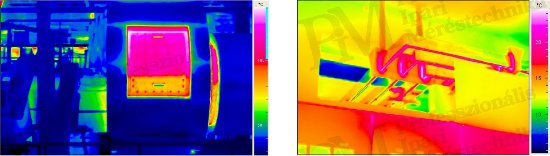
| Left image: thermal image of a hot air fan - the polished aluminum insulation cover has a very low emissivity value - the actual temperature of the hot air fan can be seen through the rusty inspection hole (>160°C), while the rest reflects the ambient temperature - the temperature of the insulation (>90°C) is not visible Right image: new - polished surface - copper strip - the bottom of the copper strip appears warmer than the rest, although due to copper's good thermal conductivity, there are no differences - the visible heat effect is due to the reflection of warm devices located under the copper strip |
Figure 1: Examples of objects with low emissivity - difficult to measure - [source: PIM Ltd.]
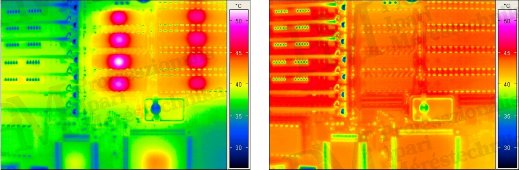
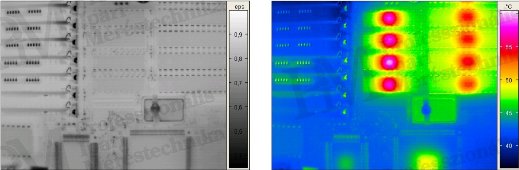
As an explanation, in both cases, the emissivity value is close to "0", meaning that the radiation usable for temperature calculation based on the object's temperature is almost non-existent. In practice, this fact is of great importance: we must acknowledge that, for example, thermal insulations with covers made of new - nicely polished - aluminum or stainless steel cannot be inspected with thermographic devices. It does not matter what temperature (even extremely hot) the measured surface is, we will always only see ( "measure") the temperature of the surrounding objects reflected on it. A similar situation arises when examining brand-new electrical installations, switchgear cabinets: the metallic (polished) rails, connections, joints cannot be determined non-contact. (However, oxidized or painted /insulated/ surfaces can be measured - as they have a high emissivity factor due to their non-metallic, matte nature.) When a thermal image contains various material surfaces, pixel-by-pixel emissivity correction may be necessary for accurate temperature calculation. As a classic example, consider assessing the thermal load of electronic circuits: there are non-metallic surfaces (ceramic, plastic, varnish) and metallic (copper, tin, nickel, and gold) surfaces. As a solution, the PCB to be inspected is uniformly heated to a temperature sufficiently different from the environment (e.g., to 50°C in a 20°C environment), and the detectable heat radiation intensity is stored as pixel-by-pixel emissivity factors. The subsequent thermal image calculation of the PCB put into operation is then performed based on the emissivity factor pixel matrix previously recorded by the software, resulting in the precise determination of the temperature data for each pixel despite the different emissivity factors.
|
Left image: PCB without emissivity correction - the hot circuit legs appear cold in reality - the cause of the incorrect data is the different emissivity values |
|
Left-side image: emissivity value of the PCB surface - determination of emission per pixel based on uniform temperature eps - pixel-wise determination of emission based on the left-side image - thus, the hot circuit legs are also hot in the thermal image |
Figure 2: Example of pixel-wise correction of different emissivity factors [source: Infratec]
Practical measurement tips
This section deals in detail with what measurements (with what results) can be carried out related to electrical equipment using thermographic methods and what to pay attention to in order to eliminate measurement errors.
Thermographic measurements related to electrical equipment
The thermographic condition assessment of electrical equipment is based on the fact that undersized or damaged cables, poor connections (due to increased transient resistance), and in most cases electrically faulty devices heat up to higher temperatures than usual (permissible). The biggest advantage of thermography is that measurements can be safely performed from a distance - even on equipment operating at several kV - without affecting the operation of the device under test. Common application areas include condition assessment of electrical equipment in the energy industry.
Electrical faults detectable by thermography
Important advice
|
|
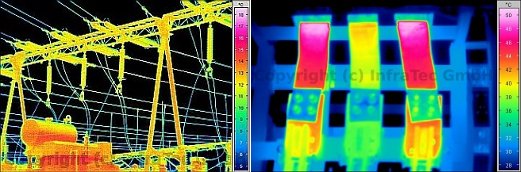
| Figure 3: Substation [source: Infratec] Figure 4: Busbars [source: Infratec] |
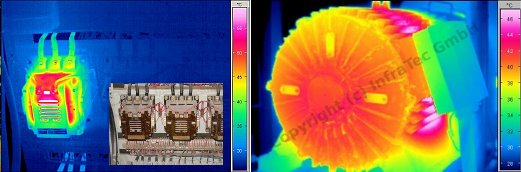 |
| Figure 5: Transformer (thermal image + integrated digital photo) [source: Infratec] Figure 6: Electric motor [source: Infratec] |
Tips for selecting the appropriate thermal camera based on the measurement task
While in the previous section we explained the meaning of technical parameters characteristic of thermal cameras, in the following, we provide the selection criteria for the appropriate measuring instrument (thermal camera) based on professional fields. Survey of electrical equipment
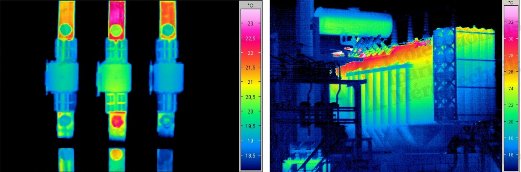 |
| Figure 7: Industrial fuse inspection [source: Infratec] Figure 8: Industrial transformer survey [source: Infratec] |
- wavelength range: long-wave (Note: The typical temperature range of electrical equipment is between 0°C and 200°C. These measurements are best performed with a long-wave thermal camera, as bodies at these temperatures emit predominantly long-wave radiation according to Planck's law. On the other hand, this range can also be detected more favorably with thermal/microbolometer detectors compared to photon detectors.)
- measurement (calibration) range: min. 0°C ... 150°C or better: -20°C ... 250°C (Note: The measurement range should be selected based on the expected temperatures of the equipment to be measured. If a thermal camera with a wider calibration range is available at a similar price, it is advisable to choose that for safety. Cameras calibrated from -20 or -40°C provide the best image quality due to lower noise levels.) - number of pixels: min. 160x120 or 320x240 pixels, better 384x288 or 640x480 pixels (Note: With fewer pixels, only very small areas can be captured - for example, with 120x160 pixels, only a part of a switchgear /depending on the smallest cable cross-section, only a quarter or eighth/ can be recorded in a thermal image. Therefore, using such a small camera is suitable for fault detection, especially when there is automatic visual or acoustic alarm for threshold exceedance, but documenting complete electrical networks or manufacturer equipment is not cost-effective due to the multitude of images and necessary thermal image montages.) - geometric resolution: min. 2 mrad, better 1.5 mrad, best 1 mrad (Note: Since it is necessary for at least 2 elementary pixels to fall on the smallest object to be measured /the smallest cable cross-section/, the geometric resolution limits how far thermal images can be taken. With a "poor" geometric resolution thermal camera, this can lead to the need for 8-10 images per switchgear for each cable and connection to be correctly surveyed. - temperature resolution: 100 mK or better: 80 mK or even 50mK (When inspecting electrical equipment, significant temperature differences can be expected, so temperature resolution is not as critical.) - image capture frequency: no restriction, but it is advisable to choose a 50Hz camera for manual captures (Note: The image capture frequency of a thermal camera is important, as slow cameras with frame rates of 9, 15, or 30 Hz require the use of a camera stand to avoid blurring due to hand tremors. Faster cameras /min. 50Hz/ allow handheld image capture.) - recommended "special" features selectable color palette, autofocus, built-in digital video camera, or composite imaging (visual and thermal images superimposed)
Microelectronic measurements (processes involving rapid temperature changes)
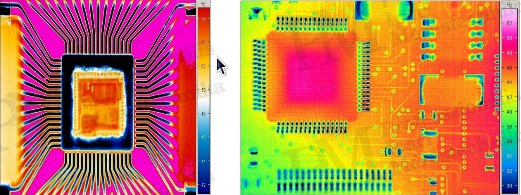 |
| Figure 9: Integrated circuit with microscope lens [source: Infratec] Figure 10: PCB standard lens [source: Infratec] |
- wavelength range: long-wave (Note: The typical temperature range of electronic devices is between 0°C and 200°C. These measurements are best performed with a long-wave thermal camera, as bodies at these temperatures emit predominantly long-wave radiation according to Planck's law.)
- measurement (calibration) range: min. 0°C ... 150°C or better: -20°C ... 250°C (Note: The measurement range should be selected based on the expected temperatures of the electronic device to be measured. If a thermal camera with a wider calibration range is available at a similar price, it is advisable to choose that for safety. Cameras calibrated from -20 or -40°C provide the best image quality due to lower noise levels.) - number of pixels: min. 160x120 or 320x240 pixels, better 384x288 or even 640x480 pixels (Note: With fewer pixels, only very small areas can be captured - for example, with 120x160 pixels, only a couple of surfaces of an integrated circuit can be recorded in a thermal image. Therefore, using such a small camera is suitable for fault detection, especially when there is automatic visual or acoustic alarm for threshold exceedance, but surveying and documenting complete PCBs /electronic panels/ requires a multitude of images and thermal image montages.) - geometric resolution: min. 1.5 mrad, better 1 mrad (Note: Since it is necessary for at least 3 elementary pixels to fall on the smallest object to be measured /the smallest cross-section of an electronic circuit pin or printed wire/, the geometric resolution limits how far thermal images can be taken. With a "poor" geometric resolution thermal camera, this can lead to the need for 8-10 images per PCB for each component and wire to be correctly surveyed. - temperature resolution: 100 mK or better: 80 mK or even 50mK (When measuring electronic devices, significant temperature differences can be expected, so temperature resolution is not as critical.) - image capture frequency: > 2 x process frequency (Note: This is one of the most critical parameters for thermal cameras in fast processes. Since capturing thermal images is considered digital sampling, it is necessary to adhere to the basic principle of digital signal processing, the Shannon theorem. Accordingly, the image capture frequency must be at least twice as fast as the highest frequency component of the process. For example, if a power electronics system heats and cools at a 50Hz supply frequency, the image capture frequency should be higher than 100Hz. Otherwise, the so-called.Aliasing effect occurs and due to undersampling, slower processes / changes are observed in the representation of the temperature process over time than they actually occur. ) - recommended "special" functions selectable color scale, autofocus, differential recording (what has changed compared to the reference thermal image), series recording, pixel-wise emissivity correction (components used in electronics - copper, ceramic, plastic - have very different emissivity factors, manual correction of many small surfaces is almost impossible). Survey of overhead power lines
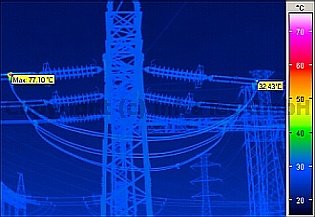 |
| Figure 11: Inspection of overhead lines, connections, and insulators [source: Infratec] |
- wavelength range: long-wave (Note: The temperatures measurable on overhead power lines can vary significantly depending on their load. A temperature range of 10...150°C can be considered typical (in summer, at night). Measuring such temperatures is best done with a long-wave thermal camera, as bodies emit predominantly long-wave radiation at these temperatures according to Planck's law.) - measurement (calibration) range: -20°C ... 120°C or better: -40°C ... 300°C (Note: Since outdoor measurements are involved, they should be carried out at night. Depending on the season, it may happen that the temperature drops below -10°C during the measurement, in which case only thermal cameras with a calibration range starting from -20°C can produce acceptable quality images. Cameras calibrated from -40°C provide even better image quality as they have lower noise levels. Therefore, we recommend the use of thermal cameras calibrated from -20°C or -40°C.) - number of pixels: min. 160x120 or 320x240 pixels, better 384x288 or even 640x480 pixels (Note: With a smaller number of pixels, only very small areas - e.g. a single insulator with 120x160 pixels - can be captured in a thermal image. Surveying an overhead power line section would therefore require a large number of images, which would also entail significant processing work.) - geometric resolution: min. 0.3 mrad or better 0.2 mrad (Note: This is the most critical parameter when surveying overhead power lines! To measure the temperature of a 20 mm diameter conductor correctly at a height of 30 m /at least two elementary pixels should fall on its surface/, a geometric resolution of 0.3 mrad or better is required. Since there is a "gap" between the pixels of matrix cameras, an even stricter condition should be applied /3 pixels should fall on the surface/, therefore accurate measurement can only be guaranteed with 0.2 mrad resolution.) - temperature resolution: 100 mK or better: 80 mK or even 50mK (The most common temperature differences are expected at the faults on overhead power lines, so temperature resolution is not as critical.
- image acquisition frequency: no restrictions for image acquisition from ground or stationary vehicles (Note: The image acquisition frequency of a thermal camera is subject to the requirement that with slow - e.g. 9, 15, or 30 Hz frame rate - cameras, a camera stand must be used, and the moving (swinging) conductor cannot be measured. For 50Hz (and higher) cameras, a stand is also necessary, as otherwise the distant conductor or insulator cannot be "aimed at." Based on practical experience, the use of cameras with a minimum of 50Hz is recommended.)
- recommended "special" functions selectable color scale, autofocus, appropriate telephoto lens, possibly composite imaging (visual and thermal images superimposed), camera stabilizer required for image capture from a moving vehicle. - not recommended optional helicopter flyover of overhead power lines, as this is related to perfect visibility conditions, which practically means daytime, clear sky flight (measurement results on the metallic conductor are expected to be unusable due to sunlight reflection)
Rahne Eric (PIM Ltd.) pim-kft.hu, termokamera.hu
The content of the publication is protected by copyright, and its (even partial) use, electronic or printed re-publication is only permitted with the indication of the source and the author's name, and with the author's prior written permission. Violation of copyright (Copyright) will result in legal consequences.
Copyright © PIM Professzionális Ipari Méréstechnika Kft.
2026 | Minden jog fenntartva
Impresszum | Adatkezelés