


Loose Machine Components, Mechanical Play
Loose elements and large clearances primarily result in high radial vibration peaks at multiples of the rotational frequency, such as 1-, 2-, 3- or 4-times, and even 5-10-times. Thus, the presence of looseness can clearly be detected in the spectrum (see diagram below), but for diagnosis - due to the direction-dependent nature of vibrations - measurements need to be taken both horizontally and vertically. In many cases, vibrations are strongest horizontally, weaker vertically, and axial vibrations are either minimal or absent. In addition to the rotational frequency multiples, subharmonics (typically at 1/2 times the rotational frequency) and interharmonics (3/2, 5/2, etc. multiples of the rotational frequency) may also be expected. In severe cases, vibration components may occur at 1/3-1/4 times the rotational frequency and its harmonics. Since the exact loose element cannot be determined from the nature of vibrations, problematic components can only be identified through an exclusion method. There are several procedures for this, but two are highlighted here: Instrumental Measurement Two machine elements in close mechanical connection should exhibit similar vibration characteristics in terms of magnitude and spectrum on both sides of the connection to rule out looseness. Manual Inspection Machine elements, such as machine base, main units, isolators, bearing blocks, and bearing housings, can be checked by placing a finger on the assembly gap: where a "pinch" can be felt at the assembly joint, there is a varying gap size - indicating a loose element. If no signs of looseness are found, then - by exclusion - there may be excessive clearance in the shaft bearings or the looseness may be within the rotating part itself.
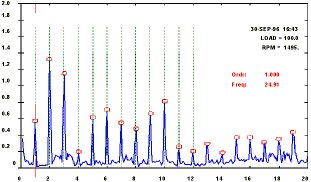
Figure: Typical Vibration Spectrum in the Presence of Looseness [source: DDC]
Vibration Phenomena in Belt Drives
In the case of belt drives, two types of fault phenomena can occur: those related to belt and pulley damage, and resonance of the passive (unloaded) half-length of the belt. In each case, different vibrations are generated. Belt and Pulley Damage The belt (flat, V-belt, or toothed belt) wraps around the pulleys on the driving and driven shafts. If a point on the belt is marked, its circumferential frequency will naturally be lower than the rotational frequency of the slower rotating pulley. This is the belt's fundamental frequency (abbreviated as belt frequency). The equation for belt frequency: fb = _fd * d * π_ = _fD * D * π_ ,where H H
fb is the belt frequency, d is the diameter of the smaller pulley, fd is the rotational frequency of the smaller pulley, D is the diameter of the larger pulley, fD is the rotational frequency of the larger pulley, and H is the length of the belt.
If a local damage occurs on the belt, it contacts the driving and driven pulleys once during each revolution. Particularly at the point of the fault and the pulley meeting, impact-like vibration excitation occurs - impact impulse during contact. Furthermore, belt faults can cause abrupt changes in belt tension when the damaged areas come into contact with or leave one of the pulleys.
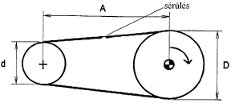
Figure: Geometrical Relationships Related to Belt Frequency [source: PIM]
Since the impact-like vibration excitation occurs twice during each revolution, the double of the belt frequency and its multiples appear as radial vibrations in the spectrum (see next figure). For toothed belts, the product of the belt frequency and the number of teeth may also occur. In the case of misalignment of the pulleys, strong axial vibrations can be expected at twice the belt frequency. It should be noted that the impacts caused by the belt are not always visible in the time domain and mostly appear very weakly in the spectra. This is because the rubber-like belt is not capable of transferring high-energy impulses to the relatively heavy pulleys.
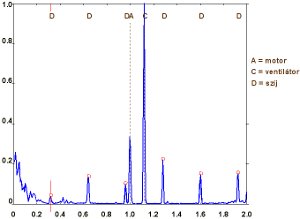
Figure: Appearance of Belt Frequency and Its Multiples in the Vibration Spectrum [source: DDC]
Resonance of the Passive (Unloaded) Half-Length of the Belt In belt drives, it often happens that the passive half-length of the belt resonates. These resonances are critical, especially when they coincide with other machine frequencies.
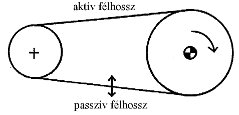
Figure: Resonance of the Passive Half-Length of the Belt [source: PIM]
During operation, it would be difficult to determine the resonance frequency of the passive half-length of the belt. It can be more easily determined in a stationary machine as follows: The belt should be excited perpendicular to its length (strictly in a stationary machine!), similar to a guitar string. The frequency of the resulting belt vibration will be slightly lower than the operational resonance frequency, but it can be a very useful approximation. (The difference is due to the presence of tensile forces during operation and the resulting changes in belt tension.)
Issues with Impellers (Fans and Pumps)
In machines with rotating blades, problems can arise not only from imbalance and looseness. These structures - such as fans, centrifugal pumps, and turbines - exhibit additional vibration-critical properties. If one or more blades are damaged in a way that changes their weight (for example, a piece breaks off), shifts their center of gravity, or simply accumulates contamination, this appears as unbalance-indicating vibration in the spectrum based on generally valid physical relationships for rotating parts. A vibration at the blade passing frequency (or simply blade frequency), which is often considered "natural" in many designs, can be attributed to a completely different cause. This vibration occurs because each blade generates a pressure impulse when passing by some obstacle. Such an obstacle can be either the incoming or outgoing stub, or any other fluid dynamics element triggering these pressure impulses. The equation for blade frequency: Fl = n / 60 × N, where
Fl is the blade frequency, n is the shaft speed, and N is the number of blades on the rotating blade.
Often, multiples of the blade frequency are present as well. This is because there can be more than one obstacle in the flow path near the blades of the device, and pressure impulse feedback can occur. Multi-stage rotating blade structures "produce" their own blade frequencies (and their multiples) separately for each stage. If there are static (guide) blades in the structure, higher frequency vibrations can also occur, whose frequency matches the product of the blade frequency and the number of static blades. Additionally, sidebands (modulations) around the blade frequency can appear in the spectra because the flow properties of the damaged blade(s) have changed, resulting in different pressure impulses. If the blade touches the casing or any other flow-guiding element, its friction or impact impulses can also be noticeable in the spectrum. Inlet and outlet pressure fluctuations can also result in sidebands at the rotation frequency. Beyond the mentioned blade frequency, there is another peculiar characteristic in fluid-carrying equipment: cavitation, which occurs when the vacuum effect in the flow becomes so strong that vapor forms from the transported liquid. This vapor release occurs in the form of smaller or larger bubbles at the location with the highest vacuum effect, directly on the sides of the blades. Since the formation of each bubble occurs as a mini explosion, it is easy to imagine how harmful it is for the surfaces of the blades. This process is audible and can be perceived in the spectrum as high-frequency, broadband vibration (as a high-value, wide frequency range noise floor), as well as an increase in multiples of the blade frequencies.
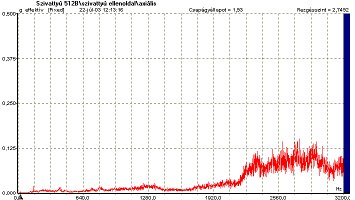
Figure: Appearance of cavitation in the vibration spectrum [source: PIM]
Rahne Eric (PIM Ltd.) pim-kft.hu, gepszakerto.hu
The content of this publication is protected by copyright, and its (even partial) use, electronic or printed re-publication, is only permitted with the indication of the source and author's name, and with the author's prior written permission. Infringement of copyright (Copyright) has legal consequences.
Copyright © PIM Professzionális Ipari Méréstechnika Kft.
2026 | Minden jog fenntartva
Impresszum | Adatkezelés