


Piezoelectric sensors, based on the piezoelectric phenomenon (generation of electric charges due to force acting on the crystal), are widely used for measuring dynamic processes such as acceleration, force, and pressure. Their main advantages include a wide frequency range, large measurement range, and compact size. However, drawbacks of such sensors include frequent calibration needs, sensitivity to electromagnetic interference, cable length, and quality of cables and connections. To address this, the American sensor manufacturer PCB developed and introduced sensors in ICP® design. ICP is a registered trademark of PCB and stands for "Integrated Circuit Piezoelectric," which refers to piezoelectric sensors with built-in amplifiers.

Structure of ICP® Sensors
The essence of the ICP® design is the integration of an amplifier, miniaturized thanks to modern microelectronics, into the housing of the piezoelectric sensor itself. This results in very simple and widely applicable sensors with the following main advantages:
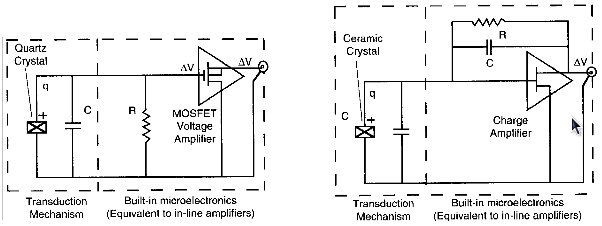
The design of the integrated amplifier in the sensor depends on whether the sensor element is ceramic-based or quartz-based and requires amplification of the electrical signal. Quartz elements with low charge capacitance can generate high voltages, hence MOSFET voltage amplifiers are integrated into such sensors. On the other hand, ceramic-based sensors produce higher charges at lower voltages, requiring charge amplifiers. The typical configurations are illustrated in the following diagram.
 |
|
internal structure of quartz-based piezoelectric sensor / internal structure of ceramic-based piezoelectric sensor |
Powering of ICP® Sensors
Measurement circuits containing ICP® sensors typically consist of the sensor, the two-core connecting cable, and the sensor interface circuit (power-coupling unit), as shown in Figure 2.
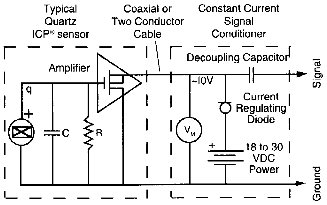 |
| Figure 2: Typical assembly of measurement circuit with ICP® sensor |
The sensor interface circuit (power-coupling unit) consists of a constant current generator powered by a DC voltage (+18…+24V) and an interfacing (DC isolating) circuit. The meter labeled Vm, with high input impedance, indicates the voltage at the sensor output, typically falling between +9…+12V DC in the quiescent state. This voltage can be used to functionally test the sensor and connecting cable in the quiescent state. The connection realized for ICP® sensors is highly immune to interference due to the relatively high signal levels, and the current generator can drive long (shielded) cables even in industrial environments.
Typical Output Range of ICP® Sensors
ICP® sensors are typically powered with a DC voltage between +18…+24V. Assuming a voltage drop of approximately 1V across the current generator and a quiescent voltage of 11V DC, the dynamic output range of the sensor under 18V supply is calculated as follows: U signal = 18V - (1V + 11V) = 6V Even under heavier loads, the sensor cannot provide a distortion-free output signal greater than this value, as it would lead to asymmetric saturation. Increasing the supply voltage can help mitigate this issue. For the above sensor, the positive saturation capability is over 10V with a +24V supply (maintaining the same 11V DC quiescent voltage). The negative saturation (in both cases) is also 10V. This relationship is illustrated in the following diagram.
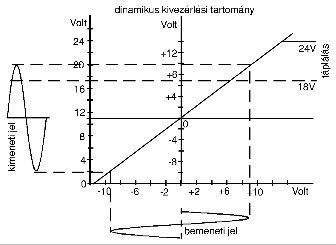 |
| Figure 3: Saturation capability of ICP® sensors based on supply voltage |
Rahne Eric (PIM Ltd.) pim-ltd.com, industrial-expert.com
The content of this publication is protected by copyright. Any (partial) use, electronic or printed re-publication, is only permitted with proper attribution of the source and author, and with the author's prior written consent. Infringement of copyright (Copyright) will result in legal consequences.
Copyright © PIM Professzionális Ipari Méréstechnika Kft.
2026 | Minden jog fenntartva
Impresszum | Adatkezelés