


The creation of thermal images, also known as thermography or - less accurately in professional terms - thermovision, is an extremely versatile measurement procedure that could not spread more rapidly in practice due to the high cost of thermal cameras. The operation of modern thermal cameras can be compared to that of common digital cameras. However, no one should believe that creating correct (from a measurement perspective) thermal images is as simple as operating the thermal camera itself. A lot of professional (theoretical) knowledge, experience, and proper measurement preparation are necessary to ensure that the images are not just beautiful colorful pictures, but also evaluable thermal images.
It is a sad experience that distributors of thermal cameras and creators of thermal images often make serious professional mistakes in relation to producing thermal images. In the following, we aim to present the theoretical background and practical aspects of thermography so that both the creators of images and the users of evaluations can better exploit the advantages theoretically offered by thermal images. Let's start with the physical principles!
Basics of Infrared Temperature Measurement
Infrared temperature measurement, based on infrared radiation, or thermography and remote temperature measurement (contactless temperature measurement, often mistakenly referred to as laser temperature measurement due to the applied laser targeting illumination), utilizes the physical phenomenon that bodies emit electromagnetic waves above absolute zero Kelvin temperature (-273.15 °C), such as radio waves, light, and heat (radiation). Infrared radiation is a part of the electromagnetic spectrum, located on the long-wavelength side of visible red light, roughly in the wavelength range of 760 nm to 1 mm. In terms of temperature measurement, the range extending up to 20 μm is significant, which can be further divided into three subranges: 0.8-2 μm for short-wave, 2-6 μm for mid-wave, and 6-20 μm for long-wave infrared radiation. The electromagnetic spectrum
| Wavelength | Wavelength Range |
| 1000 km 100 km | Long waves (RF and ELF) |
| 10 km 1 km 100 m 10 m | Radio frequencies |
| 1 m 10 cm 1 cm | Microwaves |
| 1 mm 100 µm 10 µm | Infrared radiation |
| 1 µm 100 nm | Visible light |
| 10 nm | Ultraviolet radiation |
| 1 nm 0.1 nm 0.01 nm | X-ray radiation |
| 0.001 nm 0.0001 nm 0.00001 nm | Gamma radiation |
From a technical perspective of temperature measurement, the range extending up to 20 μm is significant. This can be divided into the following parts:
| Wavelength | Infrared Subrange |
| 0.8 µm ... 2 µm | short-wave infrared |
| 2 µm ... 6 µm | mid-wave infrared |
| 6 µm ... 20 µm | long-wave infrared |
Temperature measurement is based on the electromagnetic waves (infrared radiation) emitted by the object being measured. In order to infer the temperature, the relationship between the object's temperature and the emitted radiation must be considered. This relationship is primarily determined by Planck's radiation law describing the spectral distribution of radiation emitted by an ideal radiator (black body), as well as Wien's displacement law describing the shift of the radiation maximum of lower temperature objects towards the long-wave range.
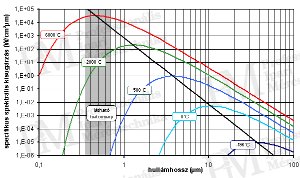 |
| Planck's radiation law [source: Infratec] |
| Radiating Body | Temperature | Radiation Maximum |
| Deep-frozen food | -18 °C | 11.4 µm |
| Skin | 32 °C | 9.5 µm |
| Boiling water | 100 °C | 7.8 µm |
| Glowing dark red iron | 600 °C | 3.3 µm |
| Glowing white iron | 1,200 °C | 2.0 µm |
Effect of Wien's displacement law: temperature dependence of radiation maximum
Properties of Measured Objects The so-called black body is the ideal physical radiation model that is essential for studying the principles of thermography. However, the objects measured in practice more or less deviate from this model, so it is important to take into account the effects of these differences in measurements. The emissivity factor (ε) serves to consider these differences, describing a body's ability to emit infrared radiation. The emissivity factor of an ideal radiator - the black body - has a value of 1, meaning it emits the heat radiation expected according to Planck's radiation law based on its temperature. The radiation capability of real bodies falls short of the black body model (thus ε<1), and their emissivity factor may depend more or less on the wavelength and temperature. Certain parameters (material composition, angle of incidence, surface coating, roughness, and degree of polarization) can also influence the composition and quantity of emitted heat radiation, and thus the results of temperature measurement based on radiation. In the long-wave range, many non-metallic materials are characterized by a high-value, relatively constant emissivity factor over a wide temperature range independent of surface processing. Good examples include human skin surface, many mineral structures, and paint based on plastic. The emissivity factor of metals is usually small, and it significantly depends on surface characteristics, decreasing with increasing wavelength (decreasing temperature). Glass is a relatively common material for measurement. Since it does not transmit infrared radiation in the long-wave range, temperature measurement through window glass is not possible at all with long-wave thermal cameras.While glass is almost an ideal emitter in a significant part of the mid-wave range, its emissivity factor in the long-wave range is only about (on average) 85 percent.
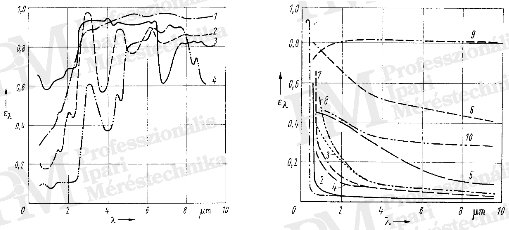
Spectral dependence of emissivity factor of non-metallic materials (1 enamel, 2 gypsum, 3 concrete, 4 refractory) [source: Infratec]
Spectral dependence of emissivity factor of metals (1 silver, 2 gold, 3 platinum, 4 rhodium, 5 chromium, 7 tantalum, 8 molybdenum) and (6 graphite, 9 selenium, 10 antimony) [source: Infratec]
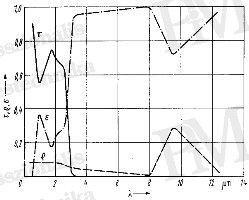
Spectral dependence of emissivity, transmissivity, and reflectivity factors of glass [source: Infratec]
Thermographic Measurement Setup
When it comes to remote heat measurement and quantitative thermography, the peculiarities of this temperature measurement procedure arising from physical fundamentals must be taken into account: firstly, it is an optical measurement method, so the measurement object must be visible from the measuring device; secondly, besides the two key elements of the measurement setup, the characteristic state of the measurement path and the possible presence of radiation sources in the foreground or background play a decisive role in the measurement.
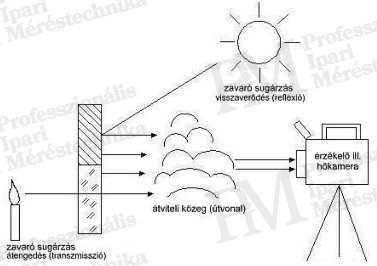 |
| Infrared remote heat measurement and thermographic measurement setup [source: PIM] |
Effect of the transmission section on the measurement result
Since infrared thermography is a non-contact method and typically not used in a vacuum, the infrared radiation forming the basis of the measurement must pass through some medium from the object being measured to the measuring device. The behavior (characteristics) of the medium in the infrared range naturally influences the measurement. In most cases, the medium is air, but other materials that transmit infrared waves (such as special measuring windows) are also encountered. In the case of air, the transmission of infrared radiation is influenced by the water vapor and carbon dioxide present in it.
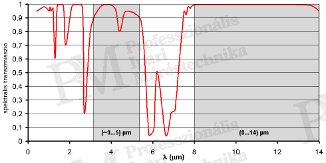 |
| Spectral transmission factor of air at 10 m, 25 °C, 1013 mbar, and 85% relative humidity [source: Infratec] |
As shown in the above figure, the transmission properties of air depend significantly on the wavelength. In regions characterized by high transmission losses, regions with good transmission capacity (shaded) can also be observed nearby. The latter are commonly referred to as atmospheric windows. While air provides almost perfect transmission in the 8...14 μm range - the long-wave atmospheric window - even over long distances, in the 3...5 μm range - the mid-wave atmospheric window - the atmosphere causes measurable losses even at distances of several tens of meters.
The measuring instrument and its effect on the measurement result Since air is the most common transmission medium in non-contact temperature measurement, it is naturally advisable and permissible to perform measurements only in the wavelength ranges provided by the atmospheric windows it offers. (Otherwise, nonlinear temperature dependencies or completely uninterpretable data would be obtained.) For measurements, thermal cameras sensitive to the 8...14 μm wavelength range - operating utilizing the long-wave atmospheric window - and capable of detecting the 3...5 μm wavelength - measuring in the mid-wave atmospheric window - are manufactured. Accordingly, they are named long-wave or mid-wave thermal cameras. Thermal cameras measuring in the short-wave range are less common. The spectral measurement range of non-contact temperature measurement instruments usually covers only a part of the total radiation emitted by the object. The impact of this on the measurement result is illustrated in the following diagram for some typical measurement ranges (applied according to the atmospheric windows).
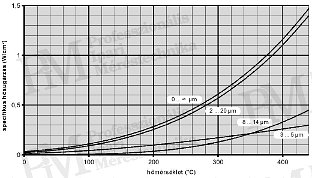 |
| Radiation-temperature curves recorded in different spectral measurement ranges [source: Infratec] |
It is easily recognizable that the mid-wave (3...5 μm) range is quite insensitive to relatively low temperatures, but (for a black body) above 350 °C, the detectability of radiation in the 3...5 μm range is better than in the long-wave (8...14 μm) range. The reason for this is that the maximum radiation has shifted to the mid-wave range. However, this is not significant in practice, as at high temperatures, the high radiation intensity already ensures an excellent signal-to-noise ratio.
Basic error sources In continuation of our previous article dealing with the theoretical basics of creating thermal images (thermography), we now turn to practical knowledge. Among these, first we list the possible error sources of non-contact temperature measurement, then we present the aspects of quantitative evaluation of measurement errors, as well as the possibilities of reducing errors. The measurement error of non-contact temperature measurement arises from several components. Firstly, among these, the measurement inaccuracy originating from the applied measuring instrument can be mentioned. Like any measuring equipment, the non-contact temperature measuring device (infrared thermometer, thermal camera) is only capable of performing its task with a certain measurement error, which can be attributed to the following:
It should also be considered that many other measurement errors may occur, which do not occur in contact temperature measurement. Below, we detail some of these possible - and particularly noteworthy - error causes.
Issues with non-contact measurement
The effect of emissivity factor and ambient temperature on measurement accuracy This is likely the most common and, in terms of error magnitude, the most significant error source during the practical application of non-contact temperature measurement method. As mentioned before, the measuring equipment can only correctly determine the temperature of an object if the emissivity factor set on the measuring device (or in the evaluation software) corresponds to the real characteristic of the object being measured. If the object being measured is not an ideal radiator (black body) with an emissivity factor of ε=1.0, then the ambient temperature must also be taken into account when determining the object temperature. (The average temperature of the space around the surface of the object being measured is considered as the ambient temperature.) Reflection of thermal radiation from the front surface of the object (radiation reflection) The more the emissivity factor of an object deviates from the ideal value of 1 (i.e., the lower the emissivity), the stronger its reflective (radiation reflection) property becomes. This results in the measuring device measuring the thermal radiation reflected from the environment on the surface of the object, in addition to (or even instead of) the thermal radiation emitted proportionally to the temperature of the object (in the worst case). However, this can be corrected by taking into account the ambient temperature if the environment is homogeneous. The situation becomes more problematic if there are significant temperature inhomogeneities or even disturbing point heat sources present in the space in front of the object. The higher the reflective capacity of the object being measured, the more difficult it becomes to accurately determine its temperature. Signal loss in the transmission stage (radiation attenuation in the atmosphere and other materials) The transmission stage is usually the ordinary atmosphere, through which only a part of the infrared radiation spectrum passes (so-called atmospheric windows). The losses that occur over greater distances are determined by factors that absorb or attenuate infrared radiation (such as fog, aerosols, high concentrations of CO2, CO, other gases, or the presence of water). Within certain limits - during signal processing - it is possible to compensate for these effects. Special care must be taken in compensation, especially when the measurement is carried out through infrared-transmitting windows (e.g., when measuring objects inside furnaces or vacuum chambers).
Quantitative assessment of errors
The sensitivity characteristic curve of the measuring equipment The characteristic curve of the measuring equipment (in the case of a device with a long-wave measurement range) is based on the integration of the Planck function over the boundaries of the 8...14 μm spectrum range, as the equipment can only detect the thermal radiation transmitted through the appropriate atmospheric window. This characteristic curve is naturally not perfectly linear, but the error resulting from this can be mathematically corrected within the measuring device.
 |
| Blackbody radiation emission in the 8...14 μm range [source: Infratec] |
Temperature measurement error depending on emissivity factor
The error resulting from the deviation of the emissivity factor from its true value can be calculated as a significantly determining component of the total temperature measurement error. The effect of the emissivity factor (at 20 °C ambient temperature) is summarized in our table. This is also illustrated by the diagram below. It can be seen that the measurement error due to incorrect emissivity factor is greater the further the temperature of the object being measured deviates from the ambient temperature. It is also noticeable that such an error can be quite large, reaching multiples of the regular internal error of the measuring device.
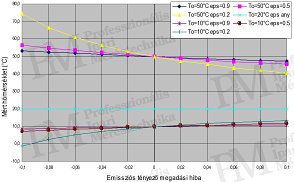 |
| Temperature measurement error due to incorrect emissivity factor in the 8...14 µm measurement range [source: Infratec] |
Possibilities for reducing measurement errors
While errors caused by reflected and transmitted disturbing radiation - based on their optical appearance (inappropriate points, spots, or circles) - are usually easy to detect and then correct in the (thermal) image taken with a thermal camera, this is not so simple in remote temperature measurement, as the distribution of radiation is not visible. In order to eliminate or at least minimize errors in temperature measurement, it is advisable to follow the following advice during the execution of measurements: Before starting the measurement, make sure that no reflected heat radiation falls into the measurement direction of the thermometer device - especially in mobile measurements. If this still occurs, perform at least one of the following steps:
It is important to note that not only obviously disturbing emitters (such as incandescent lamps, flames, hot or cold machine parts) can interfere with measurements by reflecting on the object to be measured, but the person carrying out the measurement is also a heat source and can also be reflected on the measured surface.
If the emissivity factor of the object is obviously different from that of a black body, the emissivity factor on the measuring device should be set to correspond to reality with the smallest possible deviation. Information on the emissivity factor to be set can be obtained in various ways:
If the emissivity factor is less than 1, the value of the ambient temperature also plays a role in determining the measurement value. The user must provide the value of this, as well as the emissivity of the object. Incorrect input of both parameters can lead to significant measurement errors!
If the measurement distance exceeds 10 meters in the mid-wave measurement range (this usually only occurs in remote thermal imaging), the effect of atmospheric transmission reducing radiation intensity must also be taken into account in the correction. In addition, the temperature of the measurement path must be set as accurately as possible. It is very important that in order to accurately determine the temperature, the structural element or surface to be measured on the object must not be smaller than the size of the measuring point (the projected optical image of the heat sensor on the object). Otherwise, the actual object temperature will only appear in part of the measured area, with the rest being filled by background radiation (as well as the environment of the object being measured). Within the measuring point, averaging takes place, so the true temperature of too small objects can never be determined accurately. This is especially important in the case of common "laser thermometers." In thermal cameras, this measuring point corresponds to the "projected" surface of the infrared thermal image at certain pixels.
Rahne Eric (PIM Ltd.) pim-kft.hu, termokamera.hu
The content of the publication is protected by copyright, and its (even partial) use, electronic or printed re-publication, is only permitted with the indication of the source and the author's name, and with the prior written permission of the author. Violation of copyright will result in legal consequences.
Copyright © PIM Professzionális Ipari Méréstechnika Kft.
2026 | Minden jog fenntartva
Impresszum | Adatkezelés