


The Process of Spectrum Analysis (-Evaluation)
To understand vibration spectra, we must assume that each frequency peak, as well as combinations of frequency peaks, correspond to mechanically explainable alternating forces acting on the machine. If we find a mechanical explanation associated with the peaks, we are very close to the necessary corrections. For example, the frequency spectrum can take the shape shown in the following figure.
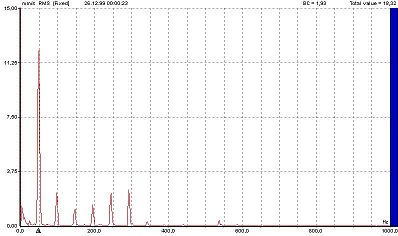 |
| Figure: typical frequency spectrum image [source: PIM] |
Each spectrum contains numerous frequency peaks, and therefore, it may seem complicated - at least initially. However, with systematic evaluation, the picture quickly becomes clear. To determine the nature and cause of vibration, we usually start by analyzing the peak with the highest amplitude in the spectrum, or the dominant peak group (harmonic frequency peaks). Knowing the typical vibration spectra of common machine faults is very helpful because we need to compare them with the actual spectrum. Next, we will examine the appearance of the most common machine faults in the spectrum.
Imbalance
Imbalance occurs when the center of mass distribution of the shaft or rotating component does not coincide with the center of rotation, resulting in a rotating centrifugal force.
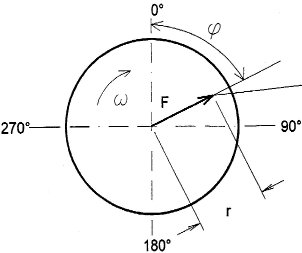
Figure: generation of centrifugal force due to imbalance [source: DDC]
The centrifugal force can be calculated based on the following equation: F = m * r * ω2 , where F ... centrifugal force, m ... unbalanced mass, r ... distance of unbalanced mass from the center of rotation, ω ... rotational speed (angular frequency). This force naturally circulates around the axis of rotation at the same frequency as the shaft rotates, causing the force acting on a point of the bearings or structural elements to be sinusoidal: reaching its maximum and minimum values once per revolution. The equation can be expressed as follows: F(t) = m * r * ω2 * sin(ω*t). Bearings and structural elements must exert an equal and opposite force to keep the shaft in place. The alternating motion that occurs - eventually measurable as vibration from the outside - also depends on the stiffness of the structural elements. From the equations, it can be seen that the effect of centrifugal force increases with the square of the rotational speed, making imbalance elimination particularly crucial for high-speed machines. In general, the following can be said about vibration caused by imbalance:
The phase angle of vibration describes the angular position of the unbalanced weight relative to a point defined on the rotating part. This value remains constant both during a full rotation (shaft revolution) and with changes in rotational speed.
Vibration velocity and displacement measurements are most suitable for assessing imbalance. If the spectrum is dominated by large, constant amplitude radial vibrations characterized by the rotation frequency, and these vibrations increase with speed but do not exhibit significant axial vibrations or multiples of the rotation frequency, then imbalance is likely present (see figure below). It is important to check if there is a significant increase or decrease in amplitude with a small change in speed, as this could indicate resonance.
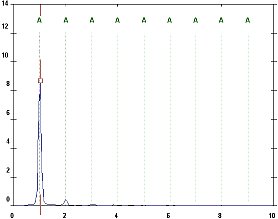
Figure: radial vibration spectrum measurable in case of imbalance [source: DDC]
Bent Shaft
Bent shafts or rotating parts are most commonly found in long rotating machines such as turbines, paper machine guide rolls, and decanters. Causes of bending can include improper transportation, thermal stress due to rapid cooling, assembly errors, or prolonged machine downtime (without periodic rotation of the rotating part) or the development of cracks in the rotating part or shaft. During measurements, bending manifests similarly to imbalance due to unilateral weight transfer, resulting in a significantly high radial vibration peak at the rotation frequency. However, the difference is that the curvature of the rotating part also forces the bearings into axial motion, in the opposite direction to the shaft. This rotational frequency vibration component can be determined by measuring the phase angle.
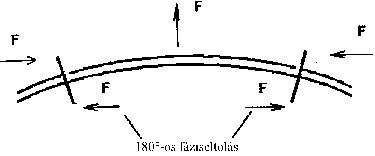
Figure: forces occurring in case of a bent shaft [source: PIM]
The most suitable method for detecting a bent axis or rotating part is vibration velocity measurement, supplemented by measuring the phase angle of the vibration component at the rotation frequency. If the spectrum is dominated by constant high-amplitude radial vibrations at the rotation frequency, which increase with the speed, and there are constant high-amplitude axial vibrations at the rotation frequency but no multiple rotation frequency vibrations are found, then it is highly likely that a bent rotor is present (see diagram below). A clear indication of a bent rotor is when the phase angle difference of the axial vibrations at the two ends of the axis, at the rotation frequency, is approximately 180°. In this case, it is also necessary to check for significant amplitude increase or decrease with small speed changes, as this could indicate resonance.
|
| Figure: Axial vibration spectrum for a bent axis [source: PIM] |
Shaft Alignment and Coupling Errors
Alignment errors occur in interconnected machine units when their shaft ends are angularly misaligned or their lateral or vertical positions do not match (see next diagram). The causes of alignment errors can be improper assembly or adjustment, thermal movement (uneven thermal expansion), stress, or changes in the position or fixation of the machine base. Alignment errors or coupling shape errors cause the shaft to experience bending stresses. At any given moment, axial forces act on a point of the shaft, elongating it, while half a turn later, forces exerting pressure will occur at the same point.
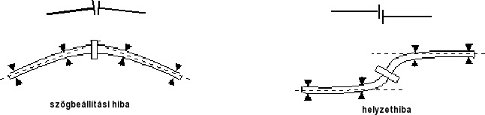
Figure: Differentiating between two fundamental shaft alignment errors [source: VMI]
Although fundamentally two types of alignment errors can be distinguished (angular misalignment and positional error, where the shafts are parallel but offset in space), in practice, we often encounter a combination of both. Both types of errors manifest similarly in the vibration spectrum: primarily the appearance of radial, twice (or occasionally three times) the rotation frequency vibrations, along with axial vibrations at the rotation frequency, characterize problems around the coupling. If the vibration at twice the rotation frequency is greater than the vibration at the rotation frequency, it is almost certain that there is an alignment error or a coupling shape error present. Additionally, higher frequency vibrations (3, 4, 5 times or more compared to the rotation frequency) may be observed. Vibration velocity measurement, supplemented by measuring the phase angle of the vibration at the rotation frequency on both sides of the coupling, is most suitable for detecting alignment errors and coupling shape errors. If the spectrum is dominated by high-amplitude radial and axial vibrations at twice and three times the rotation frequency, it is highly likely that a misalignment error is present (see diagram below). A clear indication of alignment errors or coupling shape errors is when the phase angle difference of the axial vibrations at the rotation frequency measured at the two ends of the coupling is approximately 180°. Angular alignment errors mainly cause axial vibrations at the rotation frequency, while positional errors and coupling shape errors mainly exhibit vibrations at twice and three times (sometimes four times) the rotation frequency. However, it is less clear if there are low-amplitude vibrations at 4-10 times or even higher multiples of the rotation frequency, as well as when measuring noisy and impulse-like signals, as these phenomena may also indicate loose machine components.
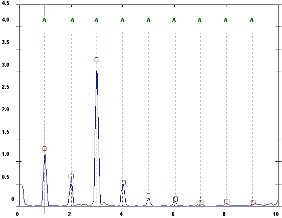
Figure: Typical frequency spectrum in case of shaft alignment error and coupling shape error [source: DDC]
Rahne Eric (PIM Ltd.) pim-kft.hu, gepszakerto.hu
The content of this publication is protected by copyright. Any (even partial) use, electronic or printed re-publication is only permitted with the indication of the source and the author's name, and with the prior written permission of the author. Violation of copyright (Copyright) will have legal consequences.
Copyright © PIM Professzionális Ipari Méréstechnika Kft.
2026 | Minden jog fenntartva
Impresszum | Adatkezelés