


Vibration velocity measurement (also known as broadband vibration measurement or vibration level measurement) is used for condition monitoring of rotating machinery. The most common handheld instruments for this purpose measure broadband (with frequency ranges from 10 to 1000, 2000, or even up to 3200 Hz) vibration velocity effective values, covering the most common frequencies typical for mechanical issues in rotating machinery. This way, it is possible to easily detect unbalance, mechanical looseness, resonance, as well as the presence of misalignments in shafts and couplings. However, specific information about which of these issues is present or dominant is not available, as we do not have frequency or phase angle data. Nevertheless, there are some methods to better identify the fault indicated by higher vibration levels. These will be explained in more detail below.
Unbalance
Unbalance is characterized by resulting radial vibrations that increase quadratically with speed; axial vibrations, on the other hand, are practically nonexistent. Since vibration level does not indicate whether the vibration component at the frequency corresponding to the speed (a consequence of unbalance) is dominant, additional measurements are needed to confirm the presence of unbalance. First, the machine should be examined for other possible sources of faults (looseness, resonance, shaft or coupling misalignment), and unbalance can be inferred based on the process of elimination. If there are previous experiences with the machine, one or two verification measurements may be sufficient (for example, fans transporting contaminated, dusty process gases are more likely to become unbalanced over time rather than experiencing an unusual machine fault). Another approach could be to balance the rotating part as a trial if the specific fault cannot be identified.
Resonances
In every rotating machine, natural excitations are present continuously, even if only to a very small extent (e.g., unbalance at base speed, single-axis error at double speed, etc.). If the frequency of any of these excitations approaches the resonance frequency of a machine component, depending on the stiffness and mass of the component, the vibration in that component will amplify, causing the component to resonate. A significantly higher vibration level appears than if the resonance and excitation frequencies were different. To detect resonance, vibration levels need to be measured in all three spatial directions at the bearing housings. If one of these measurements is three times higher than the others, it is almost certain that resonance is present. (Resonance amplifies the mechanical force in a specific direction, resulting in strong, direction-dependent vibration.) If changing the machine's speed results in significant changes in vibration levels, not only is the presence of resonance confirmed, but it is also possible to determine the resonance frequency. The resonance frequency corresponds to the rotation frequency at which the vibration is strongest.
Loose Machine Elements, Loose Fastenings
For example, by performing vibration measurements on both sides of a bolted connection, it is possible to identify loose machine elements within the connection. Two closely connected machine elements should show the same vibration level on both sides of the connection. Similarly, bolts fixed in the foundation should have the same vibration level as the foundation, provided they have not loosened. (A trick for checking without a tool: if our finger placed on the assembly gap is pinched by the varying gap, the connection of two elements is loose.)
Bent Shaft, Coupling Errors
These faults can be recognized primarily by the fact that, in addition to high radial vibrations, significantly high axial vibrations are also generated. If it is possible to determine the phase angle of the axial vibration, the presence of a bent shaft or misalignment in the coupling can be clearly proven if the phase angles of the axial vibrations measured at the bearings at both ends of the shaft or coupling differ by 180 degrees. It is characteristic that this phase angle difference remains constant when changing the speed.
Determining the Condition of Rolling Bearings by Vibration Acceleration Measurement
Within the bearing, rotating balls or rollers generate broadband noise and vibration, which increases due to poor lubrication of the bearing, overloading (e.g., due to single-axis alignment issues), or failure of the raceways or rolling elements. Since the noise and vibration generated by the bearing (otherwise high-frequency) are broadband, it is difficult to define any specific frequency or narrow frequency band that would characterize the bearing's condition for instruments measuring effective values. This is also impossible because the specific, so-called bearing fault frequencies depend, among other things, on the bearing type and the machine's current speed. In practice, the method that has proven effective is to determine the value characterizing the bearing condition based on the effective vibration acceleration measured in the frequency range between 2 kHz and 10 (possibly 20) kHz. The vibrations resulting from average unbalance or misalignments in the shafts certainly occur at frequencies below 2 kHz - below the lower frequency limit - and therefore do not affect the value characteristic of the bearing. The upper limit - 10 or 20 kHz - is selected based on the fact that the upper frequency limit of most vibration sensors without special mounting methods is 7-10 kHz, and the sensor signal would already be quite small above 20 kHz.
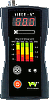
Figure: Digital handheld instrument (VMI Viber-A) for measuring broadband vibration velocity effective values and high-frequency acceleration values [source: PIM]
How to Evaluate the Bearing Condition Characteristic Value?
Instruments capable of measuring the effective value of broadband vibration velocity and high-frequency vibration acceleration can not only detect setting and balancing issues but also identify bearing faults. Moreover, they can determine which bearing of a machine needs replacement and which one does not, as well as verify whether the bearing installation was flawless and if the bearing lubrication is adequate. The bearing condition characteristic value (the effective value of vibration acceleration in the 2-20 kHz frequency range) is commonly expressed in gravitational acceleration (g). Guidance for its evaluation is provided by the following empirical graph.
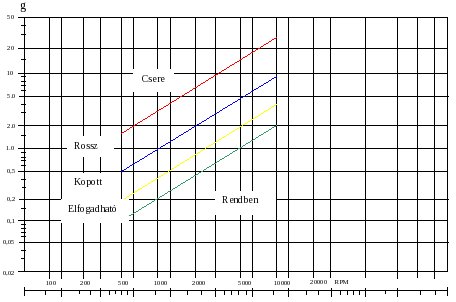 |
| Figure: Conclusions drawn based on bearing condition value [source: Vibrationsteknik] |
It is worth noting that vibrations in the 2-20 kHz frequency range can also occur due to other reasons (e.g., cavitation), resulting in a high bearing condition characteristic value without the bearing being damaged. The same applies when measuring on gear transmissions or equipment performing contact (frictional) mechanical processing, as these machines inherently produce vibrations between 10 and 20 kHz.
A significant bearing condition characteristic value can also arise when the bearing (due to misalignment issues, for example) is merely overloaded (thus free from serious damage) or when the lubrication is inadequate. This should be verified through frequency analysis (spectrum analysis) based vibration measurement.
Machine condition monitoring with trend analysis
The rate of deterioration of machine condition is the most valuable information for organizing condition-based machine maintenance, as it helps estimate when and what interventions need to be carried out to ensure the machine operates without unexpected shutdowns (and unnecessary repairs) while avoiding greater damage due to existing minor faults. To achieve this, trends of machine vibrations (the effective value of broadband vibration velocity and the value of high-frequency vibration acceleration) need to be created, where the rate of increase provides information about expected durations. The method of trend analysis is very simple: at regular intervals, the vibrations of machines need to be re-measured (at the same locations, in the same directions, and preferably with the same measuring instrument), and data for each measuring point should be evaluated graphically over time. By considering interpretable threshold values for each machine (including all measuring points and directions, as well as both mentioned vibration parameters), it can be estimated when the machine vibrations will reach the limit(s) under unchanged loads and other conditions, indicating when intervention is necessary at the latest. For many small and medium-sized companies with a large number of machines, it is no longer advisable to manually inspect the equipment with "paper and pencil," recording the vibration levels of each machine and creating separate graphs for each, or transferring the data individually to a computer. It is much more worthwhile to invest in a measuring device capable of measuring the effective value of vibration velocity and storing data for multiple machines, as well as transmitting them to a computer. The necessary instruments can be obtained at a relatively favorable price, resulting in significant benefits from their use, as maintenance planning becomes timely. Knowing when adjustments, corrections, balancing, or bearing replacements need to be done, unnecessary repairs and unexpected machine downtimes can be avoided.
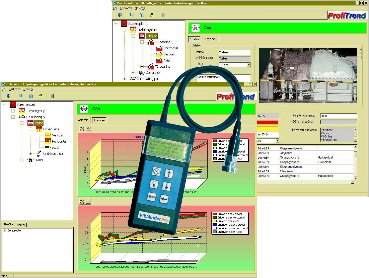 |
| Figure: Data collector handheld instrument, as well as trend creation and threshold monitoring PC software [source: PIM] |
Accurate recording of vibration trends
To ensure that trends indicating the urgency of maintenance are truly useful for estimation, in addition to the aforementioned points, other measurement rules must be followed. For example, to ensure comparability of measurement data, data should always be recorded at the same locations, in the same directions, and with the same sensor attachment (preferably using the same mounting magnet or screw fastening). During data storage, efforts should be made to record stable values (although variable vibration levels can also contain significant information about the source of vibration). Furthermore, it is crucial that only data recorded under identical measurement conditions are used for trend analysis: the machine's speed and load should be consistent for each measurement. Ideally, measurements of machines should be taken at equal time intervals. The time between two consecutive measurements can be determined based on previous maintenance experiences. One-fifth to one-tenth of the time elapsed between two previous maintenance interventions is a good estimate for determining measurement frequency. Later, this duration can be adjusted based on new experiences. Every maintenance activity, part replacement, repair, or adjustment (shaft alignment, belt adjustment, balancing), as well as unusually long downtimes, loads significantly deviating from normal in any direction, or speeds, must be documented. Without this documentation, trends cannot be evaluated clearly.
Rahne Eric (PIM Ltd.) pim-ltd.com, machineryexpert.com
The content of this publication is protected by copyright. Any (even partial) use, electronic or printed republication, is only permitted with the indication of the source and the author's name, and with the author's prior written permission. Violation of copyright will result in legal consequences.
Copyright © PIM Professzionális Ipari Méréstechnika Kft.
2026 | Minden jog fenntartva
Impresszum | Adatkezelés