


Among the contactless methods for detecting gas leaks, we can mention gas chemical sensing, ultrasonic leak detection, and leak and gas detection using thermographic (thermal imaging) devices. In the following, we will briefly discuss the latter two technologies.
Ultrasonic leak detection is suitable for detecting leaks of any gas or vapor, the higher the pressure of the escaping medium, the more reliable and sensitive this technology becomes. Its basis is the detection of ultrasound generated by the turbulence of gas escaping through a crack, which can then be made audible to the human ear or evaluated in numerical or spectrum form by transforming its frequency range. Among the advantages of this technology, it is worth mentioning that it is very cost-effective, easy to operate, and almost completely weather-independent (can be used day and night, in winter and summer). However, a disadvantage is that it cannot be used from long distances, and in the presence of multiple leaks simultaneously, it may become difficult to pinpoint the exact locations of the faults. It should also be noted that the detected ultrasound intensity often does not correlate with the size of the leak (making this method unsuitable for quantitative estimates). In contrast, leak detection technologies based on thermographic devices are capable of accurately detecting leak locations even in the presence of multiple faults (even from longer distances). However, thermographic devices suitable for such purposes (thermal cameras, infrared cameras) can only be used to detect a specific gas (or "similar" gases based on their absorption properties) depending on their measurement wavelength range, so there is no universal thermographic leak detector. Another challenge is that strict environmental conditions must be adhered to for the measurements: dry weather, free from wind and sunlight. Depending on the type of thermographic examination we want to perform, different measuring instruments and environmental conditions are required. If we want to exploit the physical fact that the escaping high-pressure gas decompresses (and cools) at the leak site, a high-quality thermal camera with a thermal sensitivity of 30mK or better and a high geometric resolution of 320x240 or higher in the long-wave (8 ... 12μm) range is required, but many environmental factors must also be considered: dry, windless weather, sunlight-free periods (nighttime). Measurements are best conducted from spring to autumn during sufficiently warm evening hours. However, if we want to take advantage of the fact that every gas can absorb (absorb) and emit (emit) certain wavelengths of radiation (electromagnetic waves), we need to select a thermal camera with a wavelength range suitable for the absorption/emission properties of the gas. For example, to detect ammonia, long-wave thermal cameras equipped with a 10 ... 11 μm bandwidth infrared filter and a minimum thermal resolution of 35 ... 50 mK are most suitable. For natural gas, the dominant gas component is methane, whose absorption bands are in the range of 1 ... 2.5 μm. Unfortunately, this wavelength range barely touches the edge of the short-wave atmospheric window, and since the emission of short-wave radiation is expected only for high-temperature bodies (according to Planck's law), a short-wave thermal camera should be selected with a detection wavelength range starting from 1 ... 1.5 μm (instead of the usual 2 μm) and unusually good thermal sensitivity (35 mK or better).
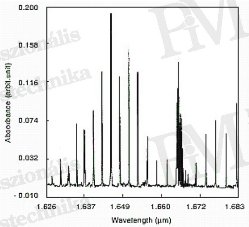 |
| Figure: methane absorption bands in the ultrashort infrared radiation range (source: Koichi Ichimura: Fiber optic methane gas detection system) |
However, when conducting measurements based on gas absorption (or emission) properties, it must be noted that this measurement will only provide reliable results if the following environmental conditions are met:
Version "A":
A sufficiently uniform - preferably in the short-wave range as well - radiating background is available - in this case, the absorption of the escaping gas can be utilized, and the gas appears as a cool cloud in front of the background
Version "B":
The escaping gas is significantly different in temperature from the environmental gas (air) - in this case, the emission of the escaping gas can be utilized, and the gas appears warmer or cooler than its surroundings
The measurement mentioned as "B" is expected to be applicable for surveying leaks in high-pressure gas pipelines only during the summer months because the gas transported at around 5°C will further cool due to decompression during the escape, making it significantly colder than the environmental air (in summer), while in winter (assuming nighttime measurements), the temperature difference compared to the air will be too small.
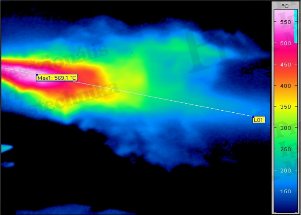 |
| Figure: common (typical) thermographic application: detection of flame temperature with a mid-wave thermal camera, 4.25 µm NBP spectral filter (source: Infratec GmbH) |
Additional note: In outdoor thermographic measurements, direct sunlight presence (>6000°C radiating heat!) should be avoided, as the evaluation of measurements becomes practically impossible due to strong reflections on the objects being measured. In addition, all kinds of coatings must be removed from the objects being measured (as infrared radiation does not penetrate most materials). In most cases, it is not possible to examine with thermographic devices whether gas shut-off valves are functioning properly, as the slight cooling caused by the small amount of leaking gas does not result in any measurable or evaluable temperature difference on the valve or pipe external surface due to its thermal conductivity and heat capacity. In such cases, the use of leak detectors based on ultrasound detection is recommended.
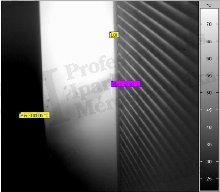 |
| Figure: Indoor thermographic application: detection of leaking gas (CO2) with shortwave thermal camera, 4.25 µm NBP spectral filter (source: Infratec GmbH) |
In summary, the search for gas leaks (especially in outdoor applications) can be best achieved with leak detection (or gas concentration measurement) devices based on chemical gas sensing. Additionally, ultrasonic leak detection can be considered for leak detection applications. Thermal imaging methods are not recommended (uneconomical) due to high investment costs (potentially several hundred times higher compared to the former technologies) and very limited usability.
Rahne Eric (PIM Ltd.) pim-kft.hu, termokamera.hu
The content of the publication is protected by copyright, and its (even partial) use, electronic or printed re-publication is only permitted with the indication of the source and author's name, as well as with the author's prior written permission. Violation of copyright (Copyright) will have legal consequences.
Copyright © PIM Professzionális Ipari Méréstechnika Kft.
2026 | Minden jog fenntartva
Impresszum | Adatkezelés