

Discovering Typical Architectural and Building Services Errors
One of the most important elements of buildings in terms of energy is their external "cladding" - the walls, openings, and roof. It is essential that these have the best possible thermal insulation properties. With thermographic equipment, thermal bridges, structures with poor insulation, joints and connections can be easily identified, as well as the condition and location of building services or electrical equipment. Additionally, thermography can reveal issues such as condensation due to evaporative heat loss, water leaks/seepage, and capillary moisture.
Recommended Measurement Conditions and Requirements
To create thermal images that allow for accurate conclusions in insulation inspections, the following conditions must be met:
From the above, it follows that the inspection of heated building insulation can only be carried out during the heating season, in appropriately cold weather (below 5 - 10°C). (Inspections of refrigerated warehouses can be done from spring to autumn.)
Other inspections, such as moisture, leaks, searching for hidden architectural elements, inspecting HVAC systems and ventilation equipment, can be carried out almost throughout the year. We just need to find (or create) thermal phenomena that result in measurable temperature differences due to variations in thermal conductivity or heat capacity.
Technical Requirements for Adequate Thermal Image Quality
For building thermography, certain quality parameters of thermal cameras must be met in order to evaluate the measurement results. Temperature resolution In building thermography, temperature differences smaller than 0.5°C must be recognizable in the thermal image, so the camera's "noise level" must be less than half of this, i.e., +/-0.125°C (125 mK). The measurement noise of thermal cameras (NETD value) is usually defined at 30°C, but this value deteriorates significantly at lower temperatures. Therefore, for building thermography, a thermal camera with at least a +/-0.08°C (80 mK) NETD value (in other words: thermal resolution) should be chosen, with 35 - 50 mK cameras being the most suitable. The calibrated measurement range of the thermal camera should start from -20°C or even -40°C: these cameras are not only low-noise but also have sufficiently stable measurement capabilities. Geometric resolution Geometric resolution significantly affects the achievable image quality and the authenticity of the image's temperature data. The IFOV (in mrad) gives the viewing angle with which an individual sensor (pixel) collects radiation from the object being measured. The smallest detectable object size is three times the product of the IFOV and the measurement distance. For objects smaller than this, the measurement spot may include both the object and the background, and averaging is done within the measurement spot. Example: To measure the upper floors of a ten-story panel building (about 30 meters high), you need to work from a good 70 m distance to avoid image distortion. The distance from the thermal camera to the object is then 76 m, with a thermal camera of 1.4 mrad resolution, the elementary measuring point has a diameter of 106 mm. Therefore, the smallest detectable object is larger than 318 mm! For smaller objects (details), a telephoto lens is needed, which (depending on the camera type) can achieve a geometric resolution of 0.2 - 0.5 mrad. Number of pixels The achievable image resolution - more precisely, the measurement detail - is determined by the number of pixels of the thermal camera. If the number of pixels is low, many shots need to be taken, and for evaluating contiguous objects and creating reports, image stitching becomes necessary (which is a very time-consuming task). To save working time, it is advisable to choose the highest possible resolution. Thanks to the development of sensors, thermal cameras with an increasing number of pixels are being produced. There are already thermal cameras with 384x288 pixels sensors available, and even devices with 640x480 pixels. A special feature is the Jenoptik company's MicroScan resolution enhancement process, which results in four times as many real measurement pixels being recorded on the built-in sensor! Example of a thermal camera meeting the above requirements: The German company Jenoptik's most versatile and sought-after product is the VarioCAM hr inspect 580 thermal camera, which allows for the capture of high-quality thermal images and is one of the most durable portable thermal cameras due to its industrial design. Features of the VarioCAM hr inspect 580 device
Examples of Building Damages and Defects Detectable with Thermography
Thermal bridges, insulation deficiencies Thermal bridges are relatively easy to identify: where an outdoor image shows the highest temperature (usually well-defined) and there is no local external heat source or reflection, a thermal bridge (or crack) is present. In indoor images, the coldest spots usually indicate thermal bridges. Discovery of hidden building construction and building services elements These measurements must be carried out using various weather or time-of-day-related heat processes. The "trick" may be measuring after daytime heating (in a period without subsequent sunlight) based on differences in heat capacity, or utilizing heat flow due to nighttime or winter cooling.
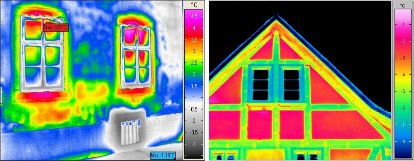 |
| Figure: Detection of thermal bridges, moisture [PIM], inspection of timber beams [Infratec] |
It is also possible to use thermographic devices to locate the position of heating pipes and hot water pipes, or even to detect leaks. These inspections should be carried out during the heating phase, before the surface reaches a homogeneous temperature distribution. In case of leaks, the temperature rise caused by the liquid exiting the pipe becomes visible in the surrounding material.
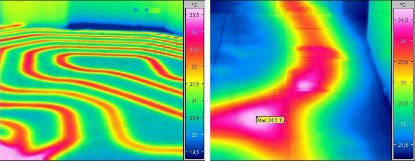 |
| Figure. Underfloor heating pipe layout, hot water pipe leakage [source: Infratec] |
Condensation and capillary moisture
During thermographic inspections, the temperature decrease caused by the heat dissipation due to evaporating moisture (the required amount of evaporation heat) can be detected. Such inspections naturally require a thermal camera with particularly good thermal resolution. This method can identify the following phenomena:
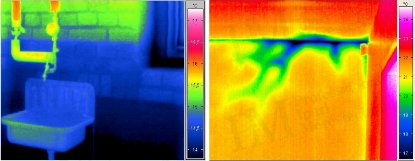 |
| Figure: Capillary moisture [Infratec], Condensation behind plasterboard [PIM] |
Air sealing problems
Not only inadequate insulation, but also unsealed openings, incomplete or completely missing vapor barrier films, poor wall connections, faulty roof sealing, etc., are responsible for energy losses. The investigation of where air flows in or out is generally done using the BlowerDoor method: by reducing the internal air pressure by 50 Pa compared to the outside with a fan, air flows in through unsealed areas from the outside. The procedure can be combined with thermographic devices, especially in winter, as the building elements cooled by the cold external air can be well detected with thermal cameras.
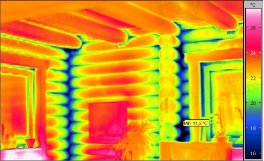 |
| Figure: Poorly air-sealed log house [Infratec] |
Rahne Eric (PIM Ltd.) pim-kft.hu, gepszakerto.hu
The content of this publication is protected by copyright, and its (even partial) use, electronic or printed re-publication is only permitted with the indication of the source and the author's name, and with the author's prior written permission. Violation of copyright (Copyright) will have legal consequences.
Copyright © PIM Professzionális Ipari Méréstechnika Kft.
2026 | Minden jog fenntartva
Impresszum | Adatkezelés