


Recommended Measurement Conditions and Requirements
Thermography, the process of taking thermal images, is an extremely versatile measurement method. Operating modern thermal cameras is similar to using common digital video cameras. However, the simplicity often emphasized by several irresponsible thermal camera distributors should not mislead anyone: professional knowledge and proper measurement preparation are necessary for correct thermal image acquisition. (Otherwise, instead of measurement results, only uninterpretable "color images" will be produced.)
It is a sad experience that both thermal camera distributors and providers of thermal image acquisition services often make serious professional mistakes regarding the creation of thermal images. Therefore, we present the most important information with practical examples below, so that both thermal image creators and users are aware of the possibilities and limitations of this technology! We have already presented the possibilities in the previous parts of our series, and now we would like to focus on the potential pitfalls to avoid.
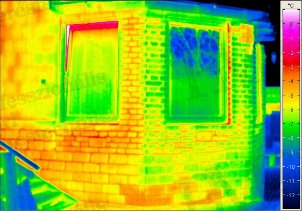 |
| Image: detection of different material qualities with thermal imaging [source: PIM] |
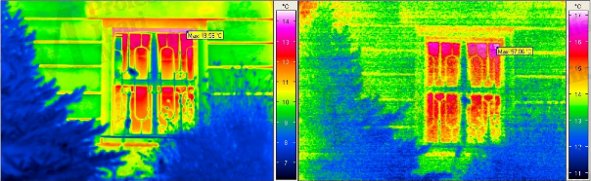
Mid-wave and long-wave thermal cameras are designed to be aligned with the atmospheric windows. While long-wave cameras can measure both the coldest and hottest objects, cold objects (e.g., -50°C) cannot be measured with mid-wave cameras. (Cold objects do not emit mid-wave radiation.) However, a significant advantage of mid-wave cameras is their ability to perform measurements through glass. This is because glass transmits short- and mid-wave radiation (up to 3.5μm), but not long-wave radiation. (Long-wave cameras, therefore, cannot "see through" glass.)
Effect of the Thermal Cameras' Wavelength Range
|
Left image: thermal image taken with a long-wave camera - very good temperature resolution, low noise - warmest spot: upper edge of a window frame (13.56°C, as it does not see through the glass) Right image: thermal image taken with a mid-wave camera - lower temperature resolution, noisier image - warmest point: a burning lamp in the room (57.06°C, as it sees the lamp through the glass) |
Effect of Environmental Parameters
When considering the theory of thermographic measurements, it becomes clear that many environmental parameters influence the accuracy of our measurements and the interpretability of the results of thermographic inspections. Building thermography can only be carried out during the heating season, in appropriately cold (below 5°C), dry, and windless weather conditions. Let us now present the importance of adhering to the above rules with thermal image examples:
Effect of Sunlight
|
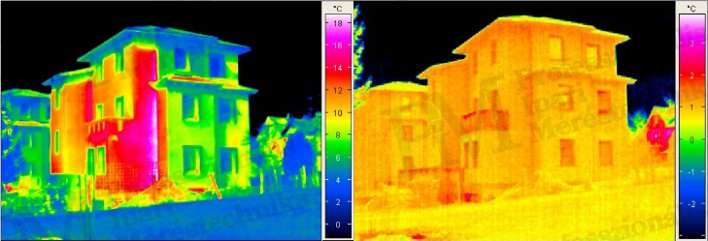
Left image: daytime building survey (construction site) - sunlight is reflected off the building walls - the walls appear warm, although there is no heating!!! Right image: building survey three hours after sunset - the heating effect of daytime sunlight is barely noticeable, allowing for measurements |
Effect of Wind
|
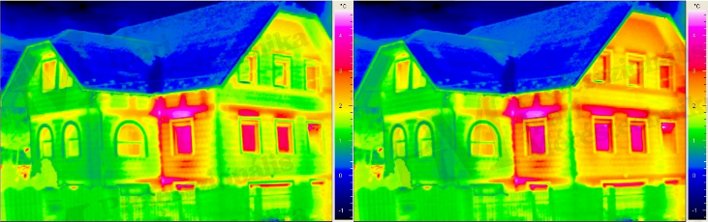
Left image: thermographic survey conducted in strong winds - the wind carries heat away from the right-side wall, making it cooler - it appears as if the wall in the middle of the thermal image has better insulation! Right image: the same survey in calm weather - it is evident that the insulation of the right-side wall is as poor as the wall in the middle of the thermal image (and has the same strong thermal bridges) |
Note for both thermal images: the left side of the building is not heated (staircase)
Effect of Strong Daytime Heating
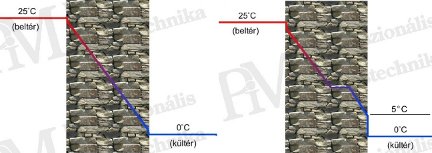
|
Left diagram: ideal temperature gradient of an external wall (steady state) - indoor (measurable) wall temperature: 21°C - outdoor (measurable) wall temperature: 3°C Right diagram: state after strong daytime heating - indoor (measurable) wall temperature: 21°C - outdoor (measurable) wall temperature: 8°C |
Note: the horizontal segment shown in the previous right diagram is the result of the temporary daytime heating effect. The diagram illustrates the thermal gradient after the evening (cooling of the external temperature). The increased temperature of the external wall surface leads to the mistaken conclusion that there is poor insulation or the presence of a thermal bridge, although the same wall structure is assumed as in the left diagram.
Effect of Leaving Windows or Doors Open
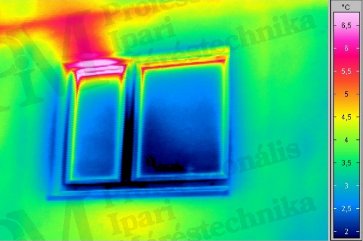
The left window was still "tilted" before the measurement, the effect of the warm air flowing out can be seen on the window frame and the wall above it. Therefore, there is no way to make a correct evaluation of the window's condition and its bridging thermal insulation properties.
Effect of Lack of Heating
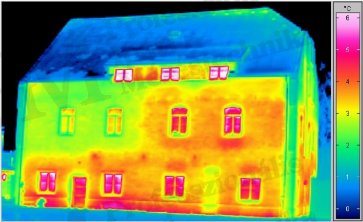
The room or apartment shown in the picture (top left) is not heated. It is not possible to detect insulation and other architectural defects in this room or apartment.
Effect of Viewing Angle on Measurement Results
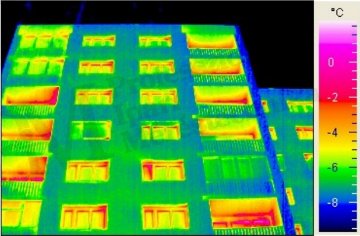
Unfortunately, the emissivity factor depends on the viewing angle as well. The more we deviate from the right angle, the more increasing reflection can be observed. This effect is most noticeable in the measurement of curved surfaces, but it is also encountered when measuring the upper floors of tall buildings: seemingly, the upper floors appear cooler (although in reality they are getting warmer). The explanation is that the sky (without clouds <-95°C) reflects more strongly on the outer surface of the building, despite the emissivity factor of the wall surfaces made of silicate-based building materials being up to 95%.
Geometric Resolution Geometric resolution significantly influences not only the image quality but also the authenticity of the image's temperature data. The IFOV parameter describing this (typically given in mrad) indicates the viewing angle that has been mapped with a unique sensor (pixel). To reproduce details well, it is important for this value to be as small as possible. For example, a 1.5 mrad IFOV means that each unique measurement point (projected measuring spot) assigned to each pixel has a diameter of 1.5 mm at a distance of 1m.
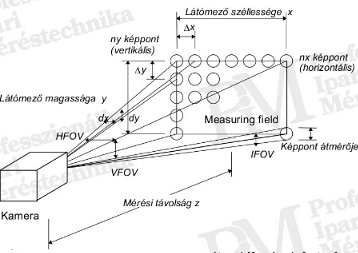 |
| Figure: Geometric parameters of the image field [source: Infratec] |
Since the "projected" position of the image point on the object is unknown and the sensor matrix itself (due to manufacturing technology) has gaps, the above pixel size must be multiplied by 3 to determine the smallest measurable object size. If this is not followed, the measuring spot may contain not only the radiation from the object's surface but also from its background (averaging within the measuring spot). Therefore, the measurement result can be either lower or higher than the actual temperature of the object, and the greater the difference in temperature between the object and the background, the greater the measurement error!
Of course, this rule applies not only to small objects (e.g., thin wires, filaments, etc.) but also to large objects (e.g., large cross-section cables, windows, etc.). Obviously, different dimensions are involved: for small objects, we talk about measuring surfaces of mm size, which can be measured from distances of up to several tens of cm based on the geometric resolution capability of the thermal camera and optics; for large objects, we talk about measuring surfaces of cm size from distances of several meters (up to 10 meters). However, in all cases, the use of tools that allow compliance with the rule is necessary! Concrete example: If we want to measure a ten-story panel building, then to measure the upper floors of the building (approximately 30 meters high), we need to work from a distance of about 60 m to minimize geometric distortion of the image (to avoid perspective effects). According to Pythagoras, the distance between the thermal camera and the object is 67 m, so with a thermal camera with a resolution of 1.3 mrad, the elementary measuring point has a diameter of 87 mm, so the smallest measurable object must be larger than 261 mm! (As a reminder: a window frame is rarely wider than 70 mm). Therefore, the use of a telephoto lens is necessary!
Discovery of Building Services Damage and Defects
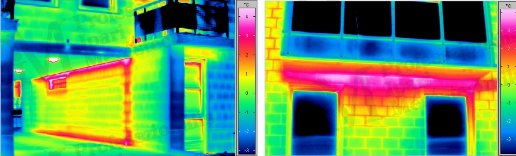
In the following, we discuss the thermographic detectability and limitations of the most common structural and building services defects. Thermal bridges, insulation deficiencies Thermal bridges are relatively easy to recognize: where the highest temperature is observed in an outdoor image, in most cases, a thermal bridge (or crack) is present. In indoor images, the coldest spots mostly indicate thermal bridges. It can also be determined which building element has better or worse insulation properties. The execution of joints and connections, structural thermal bridges caused by building elements, and "defects" from building services or electrical installations in the external walls can be examined. The only condition for the measurement is that the temperature difference between the indoor and outdoor should be at least 15 K, the wall should not be wet, and there should be no wind. (Naturally, outdoor measurements should be taken during a sunny period without direct sunlight.) Thermal bridges
|
Left image: thermal bridge caused by a concrete crown (frame) Right image: strong thermal bridge caused by the connection of the balcony wall |
Poorly Sealing Windows
|
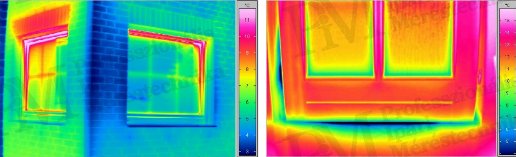
Left image: poorly sealing window (above, there is no thermal bridge!) Right image: indoor thermal image of a poorly sealing entrance door |
Discovery of Hidden Building Structural and Building Services Elements
These measurements must be carried out by exploiting various heat processes related to different weather conditions and times of day. The "trick" may involve measurements taken after daytime heating (based on heat capacity differences) or measurements based on heat flow due to nighttime or winter cooling. In all cases, the heat capacity and heat conduction differences between the materials under investigation (desired) and their surroundings must be utilized.
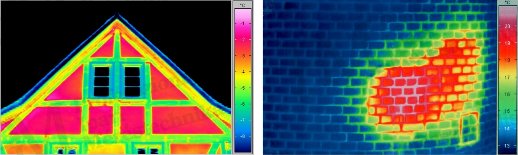
For example, with proper heat flow, iron and wooden beams in a wall become visible using thermographic tools. (Iron becomes visible between concrete or brick due to its high thermal conductivity, while wood becomes visible due to its low thermal conductivity and heat capacity.) Based on the same principle, building materials with different properties (reconstructions, extensions, additions, bricking up) can also be made visible, or even wall thicknesses can be determined (e.g., for chimney wall surveys).
|
Left image: Mapping of wooden beams under plaster (based on differences in wood and masonry thermal conductivity) Right image: Survey of chimney masonry wear (based on the thermal insulation capacity dependence on wall thickness) |
Locating heating pipes and hot water pipes
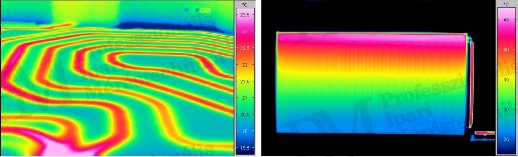
It is possible to use thermographic tools to locate the positions of heating pipes and hot water pipes. These investigations must be carried out during the heating phase, before the surface reaches a homogeneous temperature distribution. This method allows for the non-destructive verification of the positioning, density (e.g., for underfloor heating, wall heating), length, tightness of the pipes, and the venting of heating elements and pipes.
|
Left image: Positioning of underfloor heating pipes (hot spot is not leakage, but distributor!) Right image: Perfectly vented heating element |
Finding capillary moisture, condensation, and leaks
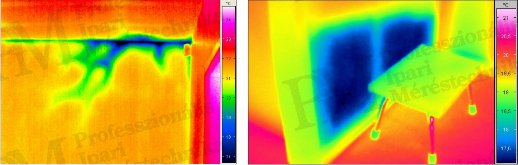
During thermographic inspection, the temperature decrease due to evaporation heat loss caused by moisture can be detected. This requires a thermal camera with particularly good thermal resolution. This method can help find roof connections, leaks due to inadequate sealing of gutters or sewage pipes, and moisture seeping up from the ground or infiltrating. This method can also reveal accumulated moisture in building materials due to condensation.
|
Left image: Moisture accumulated behind plasterboard (cause: condensation) Right image: Moistened lightweight structure wall (cause: moisture absorbed through capillary action from the concrete base) Detection of leaks and inadequacies |
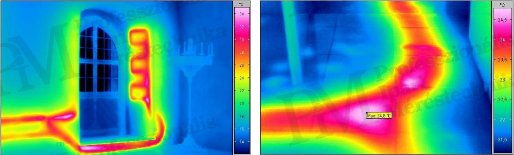
Thermal leak detection is based on the physical laws of heat conduction. If the temperature of the medium flowing in the pipe system (mostly water) is higher than its surroundings (heating or hot water pipes, underfloor heating...), heat conduction occurs through the surrounding materials to the outer (observable) surface. Thus, besides the location of the conduit, the temperature rise caused by the exiting liquid in the surrounding material can also be seen using thermal imaging tools.
In all cases, it is valid that leaks can only be detected with thermal imaging tools if a temperature difference occurs at the leak site, which can be sensed on the observable surface through heat conduction. To detect minor leaks, pressure-boosting devices should be used (along with maximum temperature application) to increase the amount of exiting medium. Leaks in cold water pipes can only be found if hot water can be connected to them. Since the exiting medium naturally "flows" within the surrounding material and collects in any existing voids, the highest temperature rise occurs where the medium can remain in larger quantities and transfer the corresponding amount of heat to the surrounding material. Therefore, the greatest heat effect may not always be visible where the leak is, but where the exiting medium accumulates. Additionally, detecting leaks is made more difficult if the surface visible with the thermal camera is shiny (reflective, polished, glazed) because the surface's heat radiation-reflective properties (low emissivity factor) make it difficult to detect small temperature differences. A different kind of problem arises when leaking pipes are concealed behind multiple layers of coverings (e.g., insulation). In such cases, the presence of insulation makes it impossible to identify the leak location unless the exiting medium flows through the insulation towards the surface to be measured.
|
Left image: Wall heating leak (at marking 1) (without knowledge of the heating pipe placement, it cannot be determined where the leak is - under 1, 2, or 3) Right image: Hot water pipe leak (the leak location cannot be clearly determined - under 1, 2, or 3) |
Rahne Eric (PIM Ltd.) pim-kft.hu, gepszakerto.hu
The content of the publication is protected by copyright. Any (even partial) use, electronic or printed re-publication is only permitted with the indication of the source and the author's name, and with the author's prior written permission. Infringement of copyright (Copyright) has legal consequences.
Copyright © PIM Professzionális Ipari Méréstechnika Kft.
2026 | Minden jog fenntartva
Impresszum | Adatkezelés