


Rahne Eric, B.Sc. in Electrical Engineering, founder of PIM Professional Industrial Measurement Technology Ltd., vibration diagnostics expert
In recent years, tools and technologies for assessing the condition of rotating machinery have advanced significantly. While not so long ago the screwdriver or the standing coin was the only common industrial "diagnostic method", it is now undeniable that the application of modern machine diagnostics is essential for achieving and maintaining cost-effective production. Recently, expert handheld machine tools are also available for this purpose!
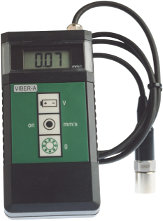
The most valuable information for organizing condition-based machine maintenance is the rate of deterioration of the machine's condition, based on which it can be estimated when and what intervention needs to be performed in order for the machine to operate without unexpected shutdowns (and unnecessary repairs), while also avoiding suffering greater damage from existing minor faults. For this purpose, machine vibrations need to be regularly measured, and the rate of their trend provides information on expected lifetimes. Simple handheld instruments rate the measured parameters (e.g., vibration velocity) with a single number. These vibration meters are compact (fit in a pocket) and very easy to operate. They most commonly measure the effective vibration velocity in the frequency range of 10...1000 or 10...3200 Hz as recommended by ISO 10816. The instruments are excellent at detecting imbalance, mechanical looseness, resonance, and misalignment. An example of a simple machine and bearing condition meter is shown in Figure 1.
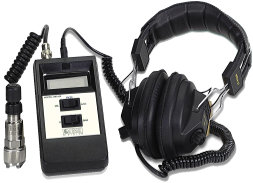
To also obtain information about the condition of rolling bearings, the high-frequency vibrations generated by the bearing components need to be measured. The most suitable indication of bearing condition has been found to be the effective value of vibration acceleration or its envelope recorded in the 2...20 kHz range. Therefore, if the instrument is suitable for measuring vibration velocity according to ISO standards and high-frequency vibration acceleration, it can not only detect setting and balancing issues but also reveal bearing faults and inadequate lubrication. Many piezoelectric vibration sensors processing vibration signals are available with a headset (including adjustable filters and amplifiers), which can also be used as stethoscopes. An example of such an instrument can be seen in Figure 2.
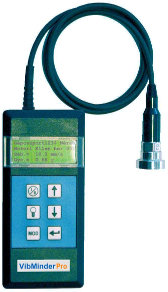
Due to the large number of machines in many companies, it is no longer advisable to record vibration values "with paper and pencil", then create graphs, or transfer the data individually to a PC. Pocket-sized data collectors are available for such tasks, capable of measuring vibration velocity and high-frequency vibration acceleration, storing data from multiple machine vibrations - even with a route - and transferring them to a PC. The accompanying PC software not only creates trends but also monitors limit values, generates various reports, and - like the PIM ProfiTrend software, for example - can log maintenance activities.
Vibration spectrum analysis is currently the most effective machine condition assessment tool (provided that the information it contains is "read" with expertise), assuming that every machine or machine component as a "rigid" body has resonance frequencies, and every machine fault results in vibrations precisely determined by the current machine speed. Through spectrum analysis of the recorded vibration signal, the "elementary" vibrations contained within become "visible", with their frequencies being associated with machine components and faults based on the above. Therefore, machine settings and individual machine element faults can be precisely identified through vibration spectrum analysis. This method is capable, for example, of separately indicating damage to the inner or outer ring or cage of a bearing! In addition to measuring the electrical parameters of electric motors, it can also identify electrical faults (e.g., breakage of squirrel cage rotor bars in asynchronous motors). As an example of the most advanced machine vibration analysis data collection device and analysis technology, we refer to the products of CSI (Emerson), as in 2004, one of the most reputable American trade magazines - "Plant Service" - readers overwhelmingly chose CSI's products as the best in the "Data Collectors and Vibration Analysis" category. CSI also took second place in the "Balancing Instruments", second in "Oil Analysis", third in "Shaft Alignment Tools", and fourth in the "Electric Motor Analysis" categories. There is no other company developing and manufacturing diagnostic tools that possess such comprehensive capabilities and leading-edge technology at the same time! Example of high-level vibration diagnostic technology (CSi PeakVue®) For detecting bearing faults, demodulation is often used, but very short-duration - pulse-like - vibrations can become invisible. The CSi PeakVue® method overcomes this limitation excellently by being suitable for early detection of bearing faults through the indication of stress waves that occur in such cases. It is noteworthy that this method can be applied even to low-speed machines and gear drives, providing reliable trend data for estimating the extent and speed of deterioration.
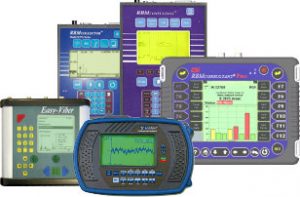
Example of an advanced instrument (CSI 2130 RBMconsultantPro)Measurement Parameters
Measurement technologies, capabilities
Special technologies
Other capabilities
Between the aforementioned machine analyzer data collectors and the machinery expert tools, a shift in perspective is primarily noticeable: while advanced machine analyzer data collectors serve a dual function (a high-level diagnostic tool in expert hands, a fast and reliable data collector in unskilled laborers' hands), the machinery expert tools now entering the market focus more on immediate, rapid analysis. Machinery expert tools largely encompass the properties and capabilities seen in machine analyzer data collectors. However, they also possess even higher-level capabilities: machine fault indication that was previously only expected from expert systems running on PCs (usually available as costly options). The result is the immediate textual display of machine faults (or faults) discovered based on measurements! With such a tool, even a skilled - but lacking in diagnostic experience - machine operator can quickly receive information on the condition of the inspected rotating machine for organizing maintenance-related decision-making. All this without external diagnostics or "human" analysis of vibration spectra. Example of a machinery expert handheld device (Vibrationsteknik ME42) The ME42 measures machine and bearing vibration, speed, and optionally temperature. But more importantly, the ME42 is a true MACHINERY EXPERT!!! It is capable not only of wideband vibration measurement according to ISO 10816, spectrum analysis, demodulation, acceleration-based and L-type bearing analysis, but also performs MACHINERY FAULT DETECTION. As a result of automatic "expert" evaluation, the device immediately displays the most likely machine fault (or faults) in text (in Hungarian!)! It presents all this with a rational, logically structured user interface, allowing for immediate fault detection even without knowledge of the device.
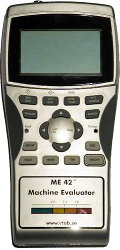
The fault detection capabilities of the ME42 rival those of expert systems running on many computers. Its greatest advantage is that during the measurement - next to the inspected machine - information on the presumed machine fault is readily available! There is nothing better than being able to receive textual information right next to the machine, enabling us to conduct further investigations quickly and efficiently, and decide on long-term maintenance scheduling or even immediate interventions. The ME42 supports various bearing condition assessment technologies: high-frequency acceleration measurement, demodulation (with adjustable filter), and the new L-type bearing condition assessment method. Whether it's lubrication deficiency or early or severe bearing damage, the device will surely detect all of these! Features
Literature [1] CSI, Knoxville, Tennessee, U.S.A. - brochures, product descriptions, manuals [2] PCB, Buffalo, U.S.A. - brochures, product descriptions, manuals [3] VMI AB, Norrköping, Sweden - brochures, product descriptions, manuals [4] PIM Professional Industrial Measurement Ltd., Budapest - brochures, product descriptions, manuals [5] PIM Professional Industrial Measurement Ltd., Budapest - Vibration Diagnostic Basics Course (educational notes), 4th edition, 2004 [5] Vibrationsteknik AB, Norrköping, Sweden - ME42 product description and manual PIM Professional Industrial Measurement Ltd. H-1221 Budapest, Tanító u. 19/A Tel.: (1) 424-00-99 Fax: (1) 424-00-97 e-mail: pim@pim-kft.hu web: www.pim-kft.hu www.termokamera.hu www.gepszakerto.hu
The content of the publication is protected by copyright, its (even partial) use, electronic or printed re-publication is only allowed with the indication of the source and the author's name, as well as with the prior written permission of the author. Violation of copyright (Copyright) has legal consequences.
Copyright © PIM Professzionális Ipari Méréstechnika Kft.
2026 | Minden jog fenntartva
Impresszum | Adatkezelés