


"A universal measurement procedure"
In the previous part of our series (Manufacturing Trend 2011/7-8), we focused on thermographic measurements on plastics, which are considered special. Now we complement this with the specifics of measurements on glass surfaces and through glass.
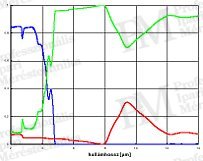
For the development and manufacturing of incandescent lamps, high-resolution, short-wave thermographic systems are often used (mostly based on InSb or PtSi matrix detectors), enabling contactless temperature measurement in the 2-6 or 3-5.5 µm wavelength range. This range is particularly interesting in glass processing and incandescent lamp manufacturing, as depending on the requirements, temperature measurement is possible both on the glass surface and through the glass. For this purpose, we exploit the difference in the optical properties of glass below and above the 4 µm wavelength: below 4 µm, measurement through glass is relatively good.
Naturally, the heat transfer-reducing effect of materials, which increases with thickness, must be taken into account in temperature calculations. On the other hand, if all short-wave radiation components are sufficiently suppressed with an overpass filter, measurement and temperature determination can be done not through the glass, but on the surface of the glass itself. Glass has lower reflection capability in the 3-5 µm short-wave range compared to the 8-12 µm long-wave range, so reflections here only slightly affect the measurement results depending on the ambient temperature level.
Temperature measurement in glass processing
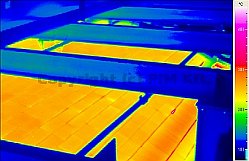
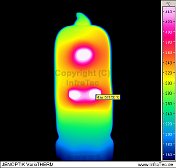
For example, in the production of incandescent lamps, measuring the glass processing temperature at various technological phases is very important, as even slight temperature changes can have a drastic impact on the final product quality. The high processing temperature of glass allows for optimal temperature measurement in the 3-5 µm spectral range. Due to the low reflection characteristic of glass in the short-wave range, reflections on the glass surface are almost negligible, and in most cases, the ambient temperature is far below the glass processing temperature. However, for precise measurement, critical observation of the environmental temperature arrangement is necessary. For instance, hot spots caused by nearby burner heads can reflect back on the glass surface in a complex manner, making it difficult to detect them as defects. In many cases, environmental disturbances can be easily identified by simply relocating the camera and then eliminating them with shading.
In automated production processes, glass components often move rapidly, requiring a high-speed thermal imaging system for displaying temperature distribution and recording (usually with a 50 Hz frame rate). For post-evaluation and data archiving, real-time digital storage on a PC is often used, requiring a high-performance computer alongside the appropriate camera interface. In such cases, it is advantageous if all camera functions can be remotely controlled.
Process-controlled measurement initiation
For regulating the temperature of identical processing steps, it is important to trigger thermal image recording in a process-controlled manner. Often, trigger signals can be easily derived from the system itself or created directly, for example, with the help of light barriers. Without triggering, differing recording times, such as rapid cooling of the object to be measured, can lead to significant variations in individual measurement results, or later, data processing can become very complex due to the object being positioned differently in the recordings. Due to the high processing temperature and the associated extreme ambient temperatures (as well as to avoid the risk of damage from splashing or cracking materials), it is recommended to place the thermal camera at a greater distance. Consequently, special telephoto lenses ensuring satisfactory geometric resolution must be used. Examination of small lamps (whose structures to be examined can be less than 0.1 mm) can only be achieved with high geometric resolution - with a focal length of 50 or 100 mm. Of course, this imposes strict requirements, including vibration-free installation of the camera. If the camera needs to be operated at a closer distance and at high ambient temperatures, it can only be used with air- or water-cooled protective enclosures. In the case of full encapsulation, wavelength-transmitting windows made of, for example, sapphire must be used to protect the optics. In most cases, the signal-weakening effect of such protective windows does not pose a problem; however, it must be considered in temperature determination. Protective windows and lenses must be protected from contamination with an air blower. Otherwise, contamination can not only result in poor-quality thermal images but can also cause significant measurement errors, as it may indicate a lower temperature than the actual one.
Measurement of incandescent internal metal components
For metals, their low emissivity factor poses additional challenges in temperature measurement. However, the high operating temperatures of incandescent filaments and electrodes are favorable because the emissivity of metals increases continuously with temperature. Since emitted radiation is approximately proportional to the fourth power of temperature, the reflected radiation component is negligibly small for incandescent filaments at very high temperatures (even with limited bandwidth).
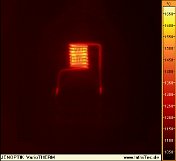
However, due to the minimal dimensions of the metallic components of the bulbs (such as the filament, electrodes), thermal cameras must meet extremely high geometric resolution requirements. Sometimes the size of these objects is in the fraction of a millimeter, so lenses with a geometric resolution of 10 µm provide the only solution. Standard lenses or teleoptics used with an extension ring may provide satisfactory results, but ultimately, they always represent a compromise: lower price comes with poorer image quality.
Rahne Eric (PIM Ltd.) pim-kft.hu, termokamera.hu
The content of the publication is protected by copyright, and its (even partial) use, electronic or printed republication is only permitted with the indication of the source and author's name, and with the author's prior written consent. Violation of copyright (Copyright) will have legal consequences.
Copyright © PIM Professzionális Ipari Méréstechnika Kft.
2026 | Minden jog fenntartva
Impresszum | Adatkezelés