

"A universal measurement procedure"
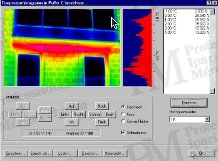
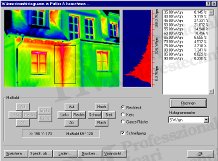
The most important evaluation of quantitative building thermography is the heat flow, followed by the numerical determination of heat loss based on this, which could represent the first important step towards energy savings.
The program performing quantitative building thermographic evaluation, providing specific numerical results, starts from the assumption that the surface temperature of the external wall is proportional to the amount of heat transported from inside to outside through heat flow. However, it is important to remember that for the evaluation to be carried out correctly, strict measurement conditions must be adhered to and fixed thermal images must be obtained; otherwise, completely erroneous data will be obtained. Based on the heat flow, the numerical value of the so-called U, or heat loss factor, can be determined. Of course, the indoor and outdoor temperatures must be provided for this.
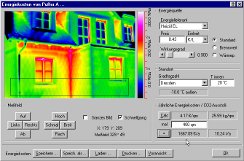
Quantification of Heating Costs
From the heat loss factor, it is not a big step to calculate the heating costs. Based on the heat loss factor, it is possible to determine how much energy is needed to heat the building (considering specific climatic conditions, the desired internal temperature, and ventilation habits). If the energy proportional costs of different heating technologies and fuels are known, the expected annual heating costs can be determined by simple multiplication.
Air Sealing Inspections
One important element of energy savings is minimizing the air exchange in the property (but not completely eliminating it, as that would lead to condensation for sure). To achieve this goal, efforts are made to install as tightly sealing doors and windows as possible. However, often the biggest air movement is not caused by poorly sealed doors and windows, but by missing or completely absent vapor barrier foils, poor wall connections, faulty roof sealing, etc., responsible for drafts.
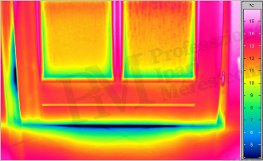
The investigation of where air flows in or out is generally done with the so-called BlowerDoor method: by reducing the internal air pressure by 50 Pa compared to the external pressure with a fan blowing air outwards, air flows in from the unsealed areas. The faster the air flows in, the stronger the air exchange, and the more energy is needed to maintain the internal temperature (as the incoming air needs to be constantly heated or cooled). The procedure can be applied year-round: in summer with anemometer airspeed meters and fog generators, and in winter even combined with thermographic devices. In winter weather, it is possible to detect well the building elements cooled by the cold external air with thermographic devices.
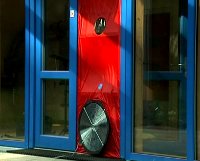
Airflow investigations can reveal the following:
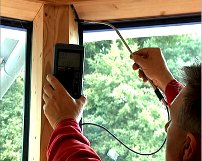
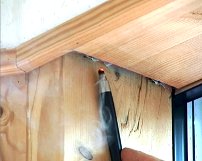
The BlowerDoor technology - supplemented with appropriate instruments - is suitable for further investigations:
Special Thermographic Measurements
In the previous chapters of our thermography series, we took examples from the "standard" thermal imaging applications, providing insights into the deeper knowledge of this universal diagnostic method. Next, we will discuss special thermographic measurements, starting with measurements on plastics. Plastics occur in thermographic practice as solid - several millimeters thick - components, or even as thin films. Due to their favorable emissivity, solid materials can be measured without problems in both the short and long wavelength ranges. However, measuring thin films is complicated because the emissivity depends on the thickness of the film.
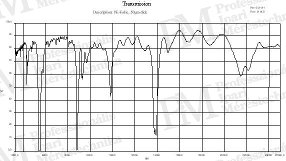
Like any other material, plastics can be characterized by specific spectral emission and transmission factors corresponding to their chemical composition. This dependence takes the form of a so-called band spectrum due to the molecular structure of plastics. They follow wide ranges showing high transmittance, followed by narrow bands that are almost completely absorbing. Since these bands also represent almost ideal emission factors, precise thermographic measurements can be performed even with thin films. For these measurements, special "plastic filters" (narrowband transmission filters) are mounted and the thermal cameras are calibrated accordingly. An important absorption band that can be used for measuring thin PE or PTFE films is located at 3.4 µm.

The variety of plastics and the range of colorants and modifiers that can be added make it impossible to provide a comprehensive overview of the spectral emission factors of different plastics. It is also unlikely to find data in the literature specifically for the composition of plastic being measured. Therefore, in most cases, experimental determination of the spectral emission factor is the only option. The necessary equipment for this, for example, is available in the thermographic laboratory of Infratec.
Rahne Eric (PIM Ltd.) pim-kft.hu, termokamera.hu
The content of the publication is protected by copyright. Any (even partial) use, electronic or printed republication, is only permitted with the indication of the source and author's name, as well as with the author's prior written consent. Violation of copyright (Copyright) will have legal consequences.
Copyright © PIM Professzionális Ipari Méréstechnika Kft.
2026 | Minden jog fenntartva
Impresszum | Adatkezelés