

"A universal measurement procedure"
Thermography, as an imaging temperature measurement procedure, primarily involves collecting temperature data (more precisely, thermal radiation intensity values). These data need to be processed appropriately during or after the measurement, followed by the challenge of displaying and/or documenting them.
Depending on the specific measurement task, the requirements for evaluating thermal images can vary significantly. While in some cases determining the specific temperature of individual pixels (measurement points) is sufficient, in other cases, capturing and evaluating entire image sequences is necessary for analyzing desired temperature processes (e.g., in the form of temperature-time diagrams). Fundamentally, we can also differentiate the evaluation (or processing) of data based on the timing: this step can be performed online (live, even in real-time) immediately during the measurement, or through offline (post-processing) of stored digital data, mostly on a PC.
On-site (immediate, live) evaluation
Often, data evaluation and "processed" visualization are required during the measurement itself. The so-called live evaluation is practically part of the operational (user) software in thermal cameras, or an "embedded" extension, integrating its management into the thermal camera's operation process. The following list summarizes the live evaluation functions integrated into most modern products:
Through these functions, for example, during inspection measurements, it is no longer necessary to evaluate thermal images individually afterwards. (Typical application case: temperatures above 50 °C were not detected anywhere – hence, we can conclude that everything is fine.) In addition to the mentioned evaluation possibilities, we also note the potential for triggering measurements, image storage, or even triggering technological processes (if the thermal camera's output is connected to the technology). It is often very helpful, for example, if image storage occurs automatically when a preset maximum value is exceeded.
Software tools for post-thermographic evaluation
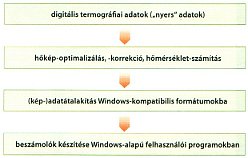
When creating thermographic reports, measurement reports, and other documentation, the method shown in our diagram assumes that the processing of special thermographic data only needs to be done with software developed for this purpose – software with special capabilities tailored to the task – until data formats or (image) information are produced that can be further processed by most users using existing Windows programs (text or image editors). The greatest advantage of this is that the convenience features of the latest hardware and software products due to the rapid development of PC technology can be immediately applied during documentation creation without the need to update or replace the specialized thermographic evaluation software.
The uniqueness of thermographic "image" data
Let's start by noting that thermographic data are not actually image data – files containing these are by no means graphic image files. The raw thermographic data (compressed into appropriate files) contain the registered radiation intensity per pixel and all other important data, allowing for the correct calculation of the temperature of each "image" or more accurately, measurement point afterwards. The content of thermographic files generally consists of the following:
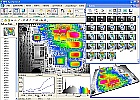
Thermographic files generally cannot be displayed with common graphic programs. The point-by-point temperatures can only be calculated with the appropriate thermographic software, as it requires a temperature calculation algorithm that corresponds to the physical model of the thermal camera, based on the relationship between radiation intensity and temperature. The specific algorithm is the intellectual property of thermal camera manufacturers and is therefore not freely accessible. This circumstance, along with the significant computational requirements, led to the introduction of various specialized software tools (thermographic evaluation software) for evaluating thermographic data. There are also "converter" type software available that convert raw data into temperature data per pixel using the appropriate algorithm (result: a matrix of digital temperature data, which, however, cannot be scaled or corrected further).
Typical application areas
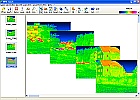
Below we review the most common application areas and typical examples of thermography. Buildings, architecture
Building and HVAC technology
Energy industry
Industrial applications in development, manufacturing, and process control
Agriculture and environmental monitoring (especially thermography from the air)
Medical applications
Rahne Eric (PIM Ltd.) pim-kft.hu, gepszakerto.hu
The content of the publication is protected by copyright, and its (even partial) use, electronic or printed further publication is only permitted with the indication of the source and author's name, as well as with the author's prior written permission. Violation of copyright will have legal consequences.
Copyright © PIM Professzionális Ipari Méréstechnika Kft.
2026 | Minden jog fenntartva
Impresszum | Adatkezelés