


"Instead of firefighting and major repairs"
When diagnosing faults in asynchronous electric motors, it can be assumed as a basic premise that electric rotating machines can be examined using the same methods as any other rotating machine. However, due to the structure and operation of electric rotating machines, not only mechanical forces occurring in the driven rotating machines and resulting vibrations are present.
The electromechanical energy conversion in electric rotating machines occurs through the mediation of electromagnetic fields. The resulting forces not only generate the desired rotational torque, but also cause the changing loads in terms of time and direction on individual machine elements - and thus their mechanical deformation. If one of the electrical elements of an electric rotating machine is damaged from an electrical perspective, this leads to the formation of an unevenly distributed electromagnetic field. Consequently, uneven, asymmetric, or time-varying mechanical loads on individual machine elements must be expected. In the case of motors, greater electrical energy consumption can result in lower mechanical power output, while for generators, the supplied electrical energy decreases while driving mechanical energy at the same time. The decrease in efficiency leads to greater losses transforming into heat, thus increasing the thermal load on components.
Cause of mechanically induced vibrations by electricity
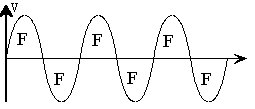
Magnetization frequency (magnetostriction effect) The torque of electric rotating machines is created through the interaction of the stationary and rotating parts' electromagnetic fields. For example, if the stator of an asynchronous motor is connected to a 50 Hz network, the poles of the stator are magnetized twice during one period of the network. This means that the poles of the stator and all components in their electromagnetic fields are subjected to a sinusoidally pulsating force twice the network frequency (magnetostriction effect).
The poles of asynchronous motors' stators are always arranged in pairs to allow the magnetic field lines to pass through the rotor. Otherwise, there would be no induction, hence no force, and ultimately no torque. Thanks to the paired arrangement - assuming a cylindrical symmetry of the stator and rotor, and perfect positioning of the rotor in the center of the stator - the radial (vibration-inducing) forces balance each other out. Since the magnetic field strength strongly depends on the air gap between the rotor and stator, it is obvious that uneven radial forces are generated when the rotor is not positioned in the center of the magnetic field. The same vibration-inducing phenomenon occurs when an asymmetric electromagnetic field is created, for example, if different currents flow through the stator coils, or if the coils themselves generate different magnetic fields. This can also occur due to manufacturing (design) errors, loose cable connections, or coil short circuits. The resulting forces always occur at twice the network frequency. It is worth noting that in single-phase asynchronous motors, the mentioned ideal - symmetrical - magnetic field does not develop, but a so-called rotating elliptical electromagnetic field is created, which can be decomposed into a high-amplitude rotating frequency (50 Hz) and a reverse rotating, lower-amplitude, 100 Hz frequency magnetic field. Therefore, in these motors, the 100 Hz vibration peak and its slip frequency sidebands are always noticeable.
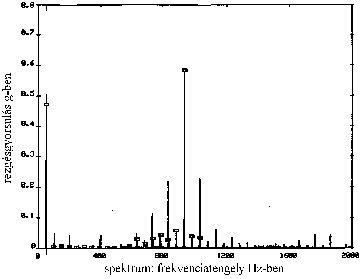
Rotor bar and slot frequency vibrations The rotor of an electric motor is usually not a homogeneous body; for example, induction motors (asynchronous motors) are equipped with built-in conductors (rotor bars). These are crucial for the formation of the desired electromagnetic interaction: during the rotational magnetic field of the rotor, the rotor bars pass in front of the stator poles. Meanwhile, voltage is induced in the bars, so current flows through them, creating an electromagnetic field around them. Based on the interaction of the field around each rotor bar and the rotating electromagnetic field of the stator, the torque of the electric motor is generated. The force induced by the interaction of the two fields reaches its momentary maximum when each rotor bar passes in front of a pole, resulting in vibrations at a frequency equal to the product of the rotation frequency and the number of rotor bars - known as the rod frequency.
The same phenomenon occurs if different currents flow through the stator coils or if the coils themselves generate different magnetic fields. This can also occur due to loose cable connections or coil short circuits. The force generated always affects the components of the electric motor at twice (and multiples of) the network frequency.
A simple method exists to determine the electrical or mechanical origin of vibrations: if the power supply to the electric motor is disconnected, electrically induced vibrations immediately cease, while mechanically induced vibrations decrease proportionally to the speed as described in our previous article on resonance testing. A significant group of vibrations caused by electrical problems are those arising from rotor faults, specifically rotor bar (pole) fractures and rotor eccentricity.
Rotor bar (pole) fractures

Electrically excited vibrations often occur at the network frequency and its multiples. If a conductor rod (bar) of the rotor is broken, the induced current can only flow through the adjacent rods. Therefore, in the case of broken rotor bars, the formation of magnetic fields and the resulting force effects are not uniform.
The uneven force effects resulting from the breakage of rods on the rotor lead to torsional vibrations, which generally become visible in the mechanical vibration spectrum in the following forms:
It is important to note that the amplitude modulation of machine vibrations due to broken rotor bars is load-dependent; however, in the case of eccentric rotor parts, there is no load-dependent variation. In normal operation electric motors, it is observed that the mechanical performance and torque of the motor decrease proportionally with the number of broken rotor bars, and thus, the speed decreases under constant mechanical load. Details on vibrations caused by rotor faults in electric motors according to the German VDI 3839 standard:
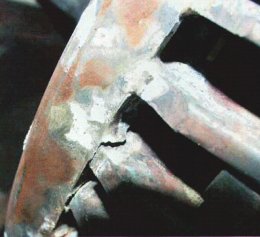
"Asymmetries in the rotor lead to modulations of bearing and housing vibrations at twice the slip frequency of the speed. These are mostly audible as machine noise. Floating is also present in the stator current, with a frequency equal to the slip frequency multiplied by double the network frequency. This can be recognized on analog current meters by periodic deflection of the pointer and can be well displayed on an oscilloscope."
"The modulation caused by the asymmetry or malfunction of the cage increases with the cage current, thus rising with the motor's performance. In two-pole machines, this is usually clearly observable and measurable. If sudden amplitude modulation of bearing vibrations occurs during operation and this modulation depends on the performance, it can be inferred with high certainty that there is a rotor fault. If the amplitude modulation has always been present or is not performance-dependent, rotor eccentricity is most likely present."
Eccentricity of the rotor
The eccentricity of the rotor's electromagnetic field can result from the rotor's eccentric geometry or broken rods or cages. Here, we only focus on phenomena resulting from the rotor's geometrical error (broken rods or cages have been discussed earlier). Geometrical eccentricity of the rotor can be a consequence of manufacturing inaccuracies or operational – mostly thermal – effects. Since rotor balancing usually occurs at the end of the manufacturing processes, the mechanical (static and dynamic) imbalance caused by rotor eccentricity is not detectable in such cases, as it has been balanced. Operational changes – such as thermal deformations – can cause imbalance, which is immediately noticeable through vibration peaks at the rotation frequency typical of imbalance.
Explanation of technical terms
Slip frequency
In induction motors, the slip frequency is the difference between the mechanical rotation frequency and the synchronous electromagnetic field rotation frequency. Slip increases with increasing load, making motor issues best examined under full load. The slip is denoted dimensionless by "s" and can be calculated as follows:
s = 1 – ( Ff / Fsyn ), where Ff is the motor rotation frequency in Hz, or the motor speed given in revolutions per minute divided by 60 Fsyn is the synchronous electromagnetic field rotation frequency in Hz, i.e., 2×Fh/P Rod frequency The rod frequency is the product of the number of conductor rods on the rotor and the rotation frequency. Electrically excited mechanical (vibration) frequency. Frúd = Ff × R, where Ff is the motor rotation frequency in Hz, or the motor speed given in revolutions per minute divided by 60 R is the number of rods on the rotor Pole modulation frequency The pole modulation frequency is the product of the number of poles and the slip frequency. A frequency electrically excited in the electromagnetic field (or in the power supply) occurring only in asynchronous motors, causing mechanical vibrations. Fpolm = Fs × P, where Fs is the motor slip frequency in Hz, i.e., 2×Fh/P-Ff Ff is the motor rotation frequency in Hz, or the motor speed given in revolutions per minute divided by 60 Fsyn is the synchronous electromagnetic field rotation frequency in Hz, i.e., 2×Fh/P P is the number of poles of the motor
Rahne Eric (PIM Ltd.) pim-kft.hu, gepszakerto.hu
The content of this publication is protected by copyright. Any (even partial) use, electronic or printed re-publication is only permitted with the indication of the source and the author's name, and with the author's prior written permission. Violation of copyright (Copyright) will result in legal consequences.
Copyright © PIM Professzionális Ipari Méréstechnika Kft.
2026 | Minden jog fenntartva
Impresszum | Adatkezelés