


"Instead of firefighting and major repairs"
The advantage of so-called feedback-based expert PC software systems drawing conclusions is that the evaluation (expertise) can be fully automated based on a good database. It is obvious that these systems meet the expectations of our time.
Based on their interactive operation, we fundamentally distinguish two types of expert systems: dialogue-based and feedback-based evaluation systems. In the case of dialogue-based expert systems, during the analysis of measurement data, the system operator (diagnostic expert, mechanical engineer, maintenance personnel, machine operator) must answer in order to assign the discovered fault phenomena to machine elements and machine faults, indicating which components and properties the examined machine has. In contrast, in feedback-based systems, the evaluation operates automatically without interactive dialogue with the expert, as the system uses all the information that has already been provided during the creation of the database. However, building the database structure for feedback-based evaluation systems is a very demanding task: decisions can only be made based on the information provided, and incorrect or missing data can lead to erroneous evaluations. Nevertheless, the advantage of systems drawing conclusions is that the evaluation (expertise) can be fully automated based on a good database.
Operation of PC-based expert systems
The evaluation of measurement data can be performed using various methods or combinations thereof, but understandably, no single development company reveals the details. However, all expert systems monitor the characteristic vibration frequencies, harmonics, and sidebands dominance. Based on the machine information stored in the database, certain machine faults can already be assigned to the discovered phenomena. The decision scheme for this (only as a theoretical detail, not related to a real system) is illustrated in the following flowchart.
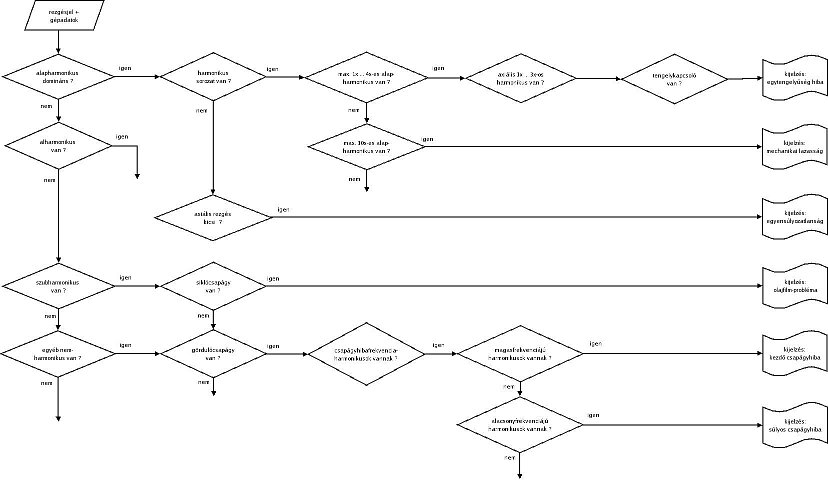
The logic of the decision mechanism roughly corresponds to the principles on which the vibration diagnostician performs the evaluation work. The real challenge arises from the multitude of occurring fault combinations (a fault phenomenon rarely occurs alone), and even more so from the fact that the data interpretation must be carried out not on individual machines, but on machine groups (e.g., electric motor+gear drive+pump) or even machine chains (e.g., two-shaft turbine+generator+exciter). Each machine has specific characteristics, but there are also interactions, vibration transfers, mutual excitations between machines. To solve this task, most expert systems first perform the evaluation machine by machine (based on the information provided in the database templates), then examine the relationship between machines (e.g., shaft coupling), and finally the effects on each other.
Expert report for a shredder with multiple faults - a typical "veterinary horse".
| ***** Diagnostic Summary ***** Database: C:RBMsuiteCustDataBács.rbm Area: (VK) Plant Machine: (Dar) HD-75 ---------------------- Nspectr Knowledge Base Version: V5.01.03 Severity Score Basis: External Envelope Diagnostic Severity Score (SEV): 100Measurement date -to - | ||
| Measurement Point(s) | Problem Description | Severity Probability |
| C2H C1H C1V C2V | Imbalance in the rotating part | 70–83 |
| C2H | Serious bearing fault | 70–83 |
| C2H C1H C1V C2V | Strongly bent shaft | 70–75 |
| C2H C2V | Horizontal resonance, bearing housing looseness | 70–69 |
| C1H | Serious bearing fault | 67–83 |
| C1H C1V | Horizontal resonance, bearing housing looseness | 64–69 |
| M2H M1H M1A M2V C2A | Shaft alignment error | 63–88 |
| M2A M2H M1H | System resonance | 63–86 |
| M2H M1H M2V | Imbalance in the rotating part | 63–80 |
| M2H M2V M2A | Vertical resonance, bearing housing looseness | 63–69 |
| M2H M1H M2V | Strongly bent shaft | 63–67 |
| C1A C2A C1V C1H C2H | Worn or stiff shaft coupling | 59–80 |
| M1H | Vertical resonance, bearing housing looseness | 57–67 |
| M2V | Serious bearing fault | 40–83 |
| C1H C1V | Looseness in the rotating part structure | 40–75 |
| C2V C2H | Bearing issue, surface damage, fractures | 18–69 |
Therefore, expert systems not only interpret machine fault-vibration frequency relationships on a per-machine basis but also apply numerous decision-making mechanisms based on logical rules and experience in the diagnostics of machine groups. In addition to the information hidden in spectra recorded at multiple measurement points and generally in all three spatial directions, depending on the capabilities and sophistication of the expert system, phase angles of machine vibrations, envelope curves, time-domain signals, special analyses (e.g., PeakVue), as well as temperature data, voltage and current spectra, field spectra, oil analysis data, and ultrasonic measurements can be used in establishing an accurate diagnosis. Some expert systems are capable of taking into account previously observed, identified, and corrected faults on the machine, or the effectiveness of previous maintenance activities during the evaluation.
Application Conditions of Systems
Regardless of how good the theoretical capabilities of expert systems sound, we must never lose sight of the fact that our systems do not "know" or "see" the equipment being examined. Defining the exact structural composition and specifying individual machine elements are the user's responsibilities. While most programs include modules for general machine layout and elements, filling these modules with appropriate technical content is still required. Therefore, it is understandable that despite having an "expert" system, it always requires a specialist for training, parameterization, and data input (especially in the case of systems drawing conclusions). The more in-depth analysis we expect from a particular system, the more thoroughly we need to build the database related to the machine. It is crucial not to skimp on either time or expertise in this work because in some cases, the hit accuracy of an expensive instrument and software package can easily surpass even the results of a very novice diagnostician. Therefore, the responsibility of the specialist(s) creating the database is enormous. A poorly constructed, inaccurate, or incomplete database expert system can provide completely erroneous results or alerts. Even worse, in some cases, it may not warn about dangerous machine faults.
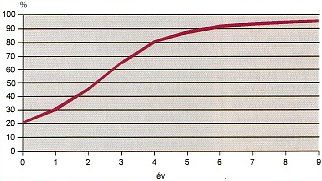
It is important to input as much information as possible about the machine, machine elements, and operating conditions into the expert system database. Furthermore, it is advantageous – especially for special machines – to integrate manufacturer limits, vibration spectra, or other reference data into the database. The efficiency of expert systems can be enhanced by providing spectra as references that we ourselves recorded when the machine was assumed to be in good condition. In such cases, the expert system bases its decisions during analysis on the vibration components that were not included in the reference spectra but can be interpreted and evaluated as potential fault phenomena.
It is almost a fundamental requirement for all vibration diagnostic software to include a bearing database and a database containing bearing fault frequencies. Expert systems, due to their level of knowledge, have been less capable of meeting such demands so far. However, good news for users is that certain expert systems (such as CSi RBMware Nspectr2) are equipped with a so-called database wizard, which offers templates for certain machine types and presents hundreds of specific machines (electric motors, generators, pumps, etc.) by manufacturer and type. And we are not only talking about data on bearings installed in the machine or the number of gear teeth: these electric motor, pump, and other databases contain up to a hundred technical data, machine design parameters, and possibly special diagnostic information for each machine. As a result, building our database is incredibly fast and almost error-free, making automatic machine diagnostics exceptionally efficient and precise.
Factors Influencing Effectiveness
Up to now, we have discussed the analysis of existing data, but it is crucial how vibration data is collected. If our expert system is based on an installed (online) measuring system, we can rely on the accuracy and authenticity of the measurements, although we may doubt whether we receive sufficient resolution and content information from a diagnostic perspective. (A full-fledged online system with satisfactory diagnostic knowledge on a multi-bearing machine is already quite costly.) However, when using manual measurement data collectors, the expertise of the personnel conducting the measurements can significantly influence the effectiveness. In such cases, it is entirely unnecessary to operate the expert system without a more knowledgeable specialist who is skilled in organizing measurements and therefore possesses diagnostic knowledge. Another aspect is that to obtain data suitable not only for fault identification but also for estimating the speed of machine deterioration, it is essential to use data recorded under identical measurement conditions. Always measure in the same place and with the same measuring equipment, ensuring that the machine's speed and load are consistent for each measurement. If the latter condition cannot be guaranteed, only an expert system capable of normalizing measurement data (standardizing it to a certain reference state) should be used. The accuracy and hit rate of the expert system's report depend on numerous factors, such as:
To enhance the effectiveness of expert evaluation, the following can be useful:
Based on the above, it is immediately clear that the opinion that any machine faults can be diagnosed with an expert system without reference and technical data, based on a single measurement, is entirely erroneous. Beyond machine faults related to rotational frequency and its harmonic vibration components, no other machine faults can be clearly diagnosed in such cases. Furthermore, there is no reliable threshold for the severity of faults, so the system cannot provide clear information on the nature of faults to be corrected or the urgency of repairs. In such cases, the capabilities of the expert system are simply not utilized.
Rahne Eric (PIM Ltd.) pim-kft.hu, gepszakerto.hu
The content of the publication is protected by copyright, its (even partial) use, electronic or printed re-publication is only permitted with the indication of the source and the author's name, and with the author's prior written permission. Infringement of copyright (Copyright) has legal consequences.
Copyright © PIM Professzionális Ipari Méréstechnika Kft.
2026 | Minden jog fenntartva
Impresszum | Adatkezelés