


"Instead of firefighting and major repairs"
When it comes to belt drives, we may encounter two types of fault phenomena: those related to belt and pulley damages, and those related to the resonance of the passive (unloaded) half-length of the belt. In both cases, completely different vibrations occur, which can also be examined using vibration diagnostics.
The belt (specifically flat, V-belt, or toothed belt) wraps around the pulley and driven shaft pulley. If we mark an arbitrary point on the belt, its circumferential frequency will naturally be lower than the rotation frequency of the slower rotating pulley. This is the belt's fundamental frequency (abbreviated as belt frequency). The equation for belt frequency is:
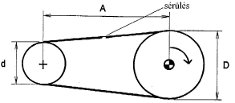
fb = _fd * d * π_ = _fD * D * π_ H H
where fb is the belt frequency, d is the diameter of the smaller pulley, fd is the rotation frequency of the smaller pulley, D is the diameter of the larger pulley, fD is the rotation frequency of the larger pulley, and H is the length of the belt.
Local Damage
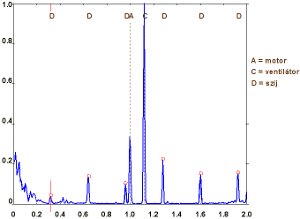
If the belt has local damage, it contacts the driving and driven pulleys once during each revolution. Particularly at the point of the fault and the encounter with the pulley, an impact-like vibration excitation occurs – the entry impulse. Furthermore, belt faults can cause sudden changes in belt tension when they come into contact with or leave one of the pulleys.
Since the impact-like vibration excitation occurs twice during each revolution, multiples of the belt frequency and its harmonics appear as radial vibrations in the spectrum. In the case of toothed belts, the product of the belt frequency and the number of teeth may also occur. In the case of misalignments of the pulleys, strong axial vibrations can be expected at twice the belt frequency. It should be noted that the impacts caused by the belt are not always visible in the time signal and mostly appear very weakly in the spectra. This is because the rubber-like belt is not capable of transferring high-energy impulses to the comparatively heavy pulleys.
Resonance of Passive Half-Length
In belt drives, it is common for the passive half-length of the belt to resonate. These resonances are particularly critical when they coincide with other machine frequencies.
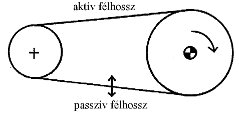
It would be difficult to determine the resonance frequency of the passive half-length of the belt during operation. It can be much more easily determined in the case of a stationary machine as follows: the belt should be excited perpendicular to its longitudinal direction by pulling (we emphasize again, in the case of a stationary machine), similar to how it is done with a guitar string. The frequency of the resulting belt vibration will be slightly lower than the operational resonance frequency but can be used as a good approximation. (The difference is due to the presence of tensile forces during operation and the resulting changes in belt tension.)
Blade Wheel Issues
Machines equipped with rotating blades can have problems not only due to imbalance and looseness. These structures – such as fans, centrifugal pumps, and turbines – have additional vibration-critical properties. If one or more blades are damaged in a way that changes their weight (e.g., a piece breaks off) or shifts their center of gravity, or if they simply become contaminated, according to general physical principles, this will manifest as unbalance-related vibration in the spectrum. A completely different cause can be attributed to the vibration at the – often "natural" in many designs – blade passage frequency (or simply blade frequency). This vibration occurs because each blade generates a pressure impulse as it passes by an obstacle. Such an obstacle can be the inlet or outlet stub, but any other fluid dynamics element can also trigger these pressure impulses. The equation for blade frequency is: Fb = n / 60 × N
where Fb is the blade frequency, n is the shaft speed, and N is the number of blades of the rotating blade.
Often, multiples of the blade frequency are present. This is because there can be more than one obstacle in the flow path near the blades of the device, and pressure impulse feedbacks can also occur. Multi-stage rotating blade structures each "generate" their own blade frequencies (and multiples) separately. The presence of static blades (guide blades) can also lead to higher frequency vibrations, the frequency of which matches the product of the blade frequency and the number of static blades.
Around the blade frequency, sidebands (modulations) at rotation frequencies can also appear in the spectra because the flow characteristics of the damaged blade(s) have changed, resulting in different pressure impulses. If the blade touches the casing or any other flow-guiding element, its friction or impact impulses can also be observed in the spectrum. Inlet and outlet pressure fluctuations can also cause sidebands at rotation frequencies.
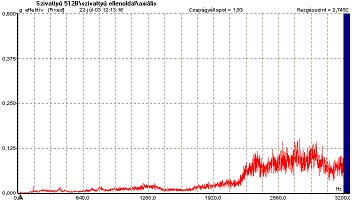
Beyond the mentioned blade frequency, there is another peculiar characteristic in devices transporting liquid: cavitation, which occurs when the vacuum effect in the flow becomes significant enough to cause vapor to form from the transported liquid. This vaporization occurs in the form of smaller or larger bubbles at the location where the vacuum effect is greatest, directly on the sides of the blades. Since the formation of each bubble occurs as a mini-explosion, it is easy to imagine how damaging this is for the surface of the blades. This process manifests as a clearly audible and high-frequency broadband vibration (as a high-value and wide frequency range noise carpet), and it is also observable in the spectrum as multiples of the blade frequencies.
Occurrence of Resonances
Mechanical structures exhibit different stiffness at different frequencies. At frequencies where the structure's stiffness is low (thus having a high tendency to vibrate), even very small forces can induce strong oscillations (vibrations) in the structure. These frequencies are called resonance frequencies, and the surrounding frequency range is referred to as the resonance range. The frequency range where the structure has particularly high stiffness is called the anti-resonance range. Another important parameter is resonance damping. Damping expresses how quickly a resonance vibration induced by a single excitation decays. Hard materials (such as glass, steel, brass) generally have low damping and continue to vibrate for a long time after excitation (like a bell or xylophone). The frequency range of such resonances is usually very narrow, with significant amplitude peaks. Soft and plastic (elastic, soft) materials (such as rubber, wood) have high damping. In these materials, a very wide frequency range of resonance is usually found, with lower amplitude peaks. From the perspective of industrial rotating machinery, it can be stated that every machine has one or more resonances, as this is a property of the machine structure. The frequency range of resonances depends on the materials used and the design of the machine structure. The problem arises only when one of the existing resonance frequencies coincides with the machine's rotational frequency or its multiples. For variable speed machines (such as DC or frequency converter asynchronous motors), this is precisely the issue: the wider the operating speed range, the more likely it is that the equipment will operate at one or more resonance frequencies or their multiples. Resonance problems can be solved by structural modifications (such as changing the natural frequency of structural elements, detuning the resonance frequency, or damping the resonance), as well as by changing the excitation frequency (by eliminating the machine fault, changing the operating speed, or the mode of loading). However, before doing so, we must ensure whether we are indeed dealing with a resonance and must know its frequency. In our next section, we will address the practical implementation of this survey.
Rahne Eric (PIM Ltd.) pim-kft.hu, gepszakerto.hu
The content of the publication is protected by copyright. Any (even partial) use, electronic or printed re-publication is only permitted with the indication of the source and the author's name, as well as with the author's prior written permission. Violation of copyright (Copyright) entails legal consequences.
Copyright © PIM Professzionális Ipari Méréstechnika Kft.
2026 | Minden jog fenntartva
Impresszum | Adatkezelés