


"Instead of firefighting and major repairs"
Vibration spectrum analysis is currently the most effective machine condition monitoring tool. It is very helpful to know the typical vibration spectra of common machine faults, as these need to be compared with the actual spectrum. In the following, we will examine the appearance of the most common machine faults in the spectrum.
Each spectrum contains numerous frequency peaks, which may seem complicated at first glance. However, with systematic evaluation, the picture quickly becomes clear. To determine the nature and cause of the vibration, we generally start by analyzing the frequency peak with the highest amplitude in the spectrum, as well as the dominant peak group (harmonic frequency peaks).
Imbalance
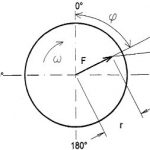
Imbalance occurs when the center of mass distribution of the shaft or rotating component does not coincide with the center of rotation, resulting in the generation of centrifugal force. The centrifugal force can be calculated based on the following equation: F = m × r × ω2, where F is the centrifugal force, m is the unbalanced mass, r is the distance of the unbalanced mass from the center of rotation, and ω is the rotational speed (angular frequency). This force naturally circulates around the axis of rotation at the same frequency as the rotation, causing the force acting on a point of the bearings or structural element to be not constant but sinusoidal: reaching its maximum once during a revolution and then its minimum. Equation: F(t) = m × r × ω2 × sin(ω × t) From the equations, it can be seen that the centrifugal force effect increases with the square of the rotational speed, so eliminating imbalance is particularly important for higher-speed machines. Bearings and structural elements must exert an equal and opposite force to keep the shaft in place. The resulting alternating motion – ultimately measurable as external vibration – also depends on the stiffness of the structural element. Therefore, the following can be said about the vibration resulting from imbalance:
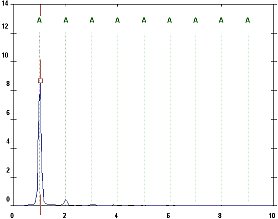
The phase angle of vibration describes the angular position of the unbalanced weight relative to a point defined on the rotating part. This value does not change either during a full rotation (shaft revolution) or with changes in rotational speed.
Vibration velocity and displacement measurements are most suitable for measuring imbalance. If the spectrum is dominated by constant, high-amplitude radial vibrations at the rotation frequency that increase with speed, without significant axial vibrations or multiple frequency radial vibrations, then imbalance is likely present. It is necessary to check whether there are significant amplitude variations for small changes in speed, as this could indicate resonance.
Bent Rotating Shaft
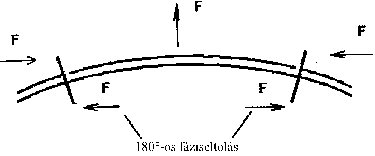
Bent shafts or rotating parts are often found on machines with long rotating parts, such as turbines or paper mill guide rollers. The bending can be caused by:
During measurements, bending manifests similarly to imbalance due to unilateral weight displacement, resulting in a prominent radial vibration peak at the rotation frequency. However, the difference is that the bending of the rotating part also forces the bearings to move axially in opposite directions. This can be determined by measuring the phase angle of the rotational frequency vibration component.
Vibration velocity measurement, supplemented by measuring the phase angle of the rotational frequency vibration component, is most suitable for detecting bent rotating shafts. If the spectrum is dominated by constant, high-amplitude radial vibrations at the rotation frequency that increase with speed, and there are also constant, high-amplitude axial vibrations at the rotation frequency, without finding multiple frequency vibrations, then a bent rotating shaft is likely present. A clear indication of the presence of a bent rotating shaft is when the phase angle of the axial vibrations at the two ends of the shaft, at the rotation frequency, differs by approximately 180°. It is necessary to check in this case whether there are significant amplitude variations for small changes in speed, as mentioned earlier, as this could indicate resonance. Shaft Alignment and Coupling Errors Alignment errors occur in interconnected machine units when their shaft ends are angularly misaligned or their lateral or vertical positions do not match.
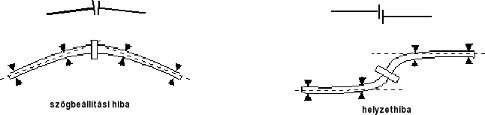
The causes of alignment errors can be:
Alignment errors (or shaft coupling alignment errors) cause the shaft system to bend, resulting in bending stresses within the shaft. Therefore, at a certain point on the shaft, axial forces act that elongate the shaft, while half a turn later, compressive forces will act at the same point.
Basically, two types of alignment errors can be distinguished: angular misalignment and offset error (the shafts are parallel but spatially displaced from each other), but most commonly, a combination of both is found. Both types of errors manifest similarly in the vibration spectrum: primarily the appearance of radial, two- (and three-) times rotational frequency vibrations, but also the occurrence of axial vibrations at the rotational frequency characterize problems around the shaft coupling. If the vibration at twice the rotational frequency is greater than the vibration at the rotational frequency, it is almost certain that there is a shaft alignment or shaft coupling-related error present. Vibrations occurring at higher frequencies, at 3, 4, 5, or multiples of the rotational frequency, may also be present.
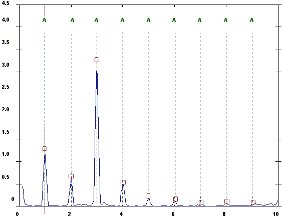
The most suitable method for detecting shaft or shaft coupling alignment errors is vibration velocity measurement, supplemented by measuring the phase angle of rotational vibration on both sides of the shaft coupling. If the spectrum is dominated by high-amplitude, two and three times rotational frequency radial and axial vibrations, then it is highly likely that there is a misalignment error present.
An approximately 180° phase difference in the rotational frequency axial vibrations measured at the two ends of the shaft coupling clearly demonstrates the presence of shaft alignment or shaft coupling errors. Angular misalignments mainly cause rotational frequency axial vibrations, while offset errors and shaft coupling errors mainly result in vibrations at two and three times (sometimes four times) the rotational frequency.
However, it is not so clear when low-amplitude, 4–10 times or even higher multiples of the rotational frequency radial and axial vibrations are present, and when measuring noisy and impulse-containing signals, as these phenomena may also indicate loose machine elements.
Loose Machine Elements, Mechanical Play
We speak of a loose mechanical connection when the machine has bearings with excessive clearance, structural elements with large mechanical play (e.g., guides) or loose structural elements, or weak attachment to the base. From a vibration perspective, large bearing clearances have the same effect as a loose bolted joint: in both cases, nonlinear components arise in the machine's natural spring constant. Vibrations due to looseness are primarily excited by the always present "residual" unbalance, and the vibrations observed at multiples of the rotational frequency are secondary results of this excitation. It should be noted that in the case of mechanical looseness, vibrations resulting from any other fault are also amplified. If looseness faults occur frequently, this can also be a consequence of resonances and/or design flaws.
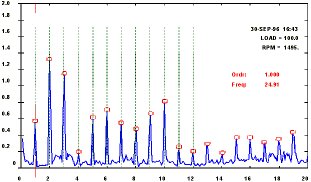
Loose elements and large clearances primarily bring about high radial vibration peaks at the rotational frequency 1, 2, 3, 4 times, and even 5–10 times multiples. Thus, the presence of looseness can be clearly detected from the spectrum, but due to the direction-dependent nature of vibrations, measurements should be taken horizontally and vertically. In many cases, vibrations are strongest horizontally, while axially they occur weaker or not at all.
In addition to the multiples of the rotational speed, subharmonic vibrations (typically at half the rotational frequency) and interharmonics (at 3/2 and 5/2 times the rotational frequency) can also be expected. In severe cases, vibration components may occur at 1/3 and 1/4 times the rotational frequency and their harmonics.
Since the nature of vibrations does not determine exactly which element is loose, the problematic component can only be identified by an exclusion method. There are several methods for this, two of which are highlighted.
If no signs of looseness are found, then – by exclusion – there may be excessive clearance in the shaft bearings or the looseness may be within the rotating part itself.
Rahne Eric (PIM Ltd.) pim-ltd.com, machineryexpert.com
The content of this publication is protected by copyright. Any (even partial) use, electronic or printed republication is only permitted with the indication of the source and the author's name, and with the author's prior written permission. Violation of copyright (Copyright) entails legal consequences.
Copyright © PIM Professzionális Ipari Méréstechnika Kft.
2026 | Minden jog fenntartva
Impresszum | Adatkezelés