


"Instead of firefighting and major repairs"
Condition-based maintenance with vibration diagnostics (VI.)
In the latest part of our technical diagnostics series, we interpreted the various vibration levels based on the measured effective value of vibration velocity, combined with practical experience. We will now move on to specific machine faults detectable by measuring the effective value. The next major unit is the assessment of the condition of rolling bearings. Following the instrumental measurement of the effective value of vibration velocity, using the ISO 10816-3 standard, it can be very easily determined whether certain machines can be operated further or not. As a basic rule, machines showing vibrations greater than 3 mm/s (including the most common types of machines such as electric motors, pumps, fans, generators) should have the cause of the vibration identified. Do not continue to operate a machine with vibrations stronger than 7 mm/s if you are not sure whether the machine's endurance allows for long-term operation under such conditions!
Machine faults detectable by effective value measurementUnbalance
Since the vibration level does not indicate whether the frequency component of the vibration (resulting from unbalance) dominates, additional measurements are needed to confirm the presence of unbalance. First, examine the machine for other possible sources of faults (looseness, resonance, measurement of shaft or coupling fault characteristics), and based on the process of elimination, unbalance can be presumed. If there is prior experience with the machine, perhaps one or two verification measurements are sufficient (for example, fans transporting contaminated, dusty, or process gases tend to become unbalanced over time rather than experiencing an unexpected machine fault). If nothing else can be imagined, try balancing the rotating part. (Balancing is the smallest material and time investment with minimal risk that can be made for "machine repair.") Unbalance is characterized by resulting radial vibrations that increase quadratically with increasing speed. However, axial vibrations practically do not occur.
Resonances
In every rotating machine, even if only to a very small extent, natural excitations are constantly present (for example, unbalance at the speed, single-axis fault at twice the speed). If one of these has a frequency that is the same or similar to a resonance frequency of a machine element, then – depending on the stiffness and mass of the affected machine component – the vibration in this machine component intensifies, causing the machine element to resonate. A significantly higher vibration level appears than if the resonance and excitation frequencies were different. To detect the presence of resonance, the vibration level must be measured in all three directions perpendicular to the bearing. If one of these is about three times larger than the others, we can be almost certain that resonance is present. (Resonance amplifies the mechanical force in a specific direction, thus creating strong – direction-dependent – vibrations.) If changing the machine speed (if possible at all) causes significant changes in vibration level, not only is the presence of resonance confirmed, but it is also possible to determine the resonance frequency: it corresponds to the rotation frequency at which the vibration is strongest.
Loose machine elements, loose fastening
For example, by performing vibration measurements on both sides of a bolted connection, it is possible to identify loose machine elements in the connection. Two closely connected machine elements should show the same vibration level on both sides of the connection, so for instance, bolts fixed in the foundation should have the same vibration level as the foundation, provided they have not loosened. (Another trick for checking without a tool: our finger placed on the assembly gap is pinched by the changing gap if the fastening of two elements is loose.)
Bent shafts, shaft coupling faults
These faults can primarily be recognized by the fact that in addition to large radial vibrations, significantly large axial vibrations are also generated. If it is possible to determine the phase angle of the axial vibration, vibration indicating a bent shaft or shaft coupling misalignment is clearly present if the phase angle of the axial vibrations measured on the bearings at both ends of the shaft or shaft coupling differs by 180 degrees. It is also characteristic that this phase angle difference remains the same when changing the speed.
Determining the condition of rolling bearings with vibration acceleration measurement
When the balls and rollers rotate inside the bearing, broadband noise and vibration are generated. This noise and vibration increase if the bearing is poorly lubricated, for example, due to overload caused by misalignment or faults on the running surfaces or rolling elements. Since the noise and vibration generated by the bearing (otherwise high-frequency) are broadband, it is difficult for a measuring instrument measuring effective value to define any specific frequency or narrow frequency band with which the bearing condition could be characterized. This is mainly impossible because the specific, so-called bearing fault frequencies depend, among other things, on the bearing type and the current speed of the machine. In practice, it has proven useful to determine the condition of the bearing based on the effective value of vibration acceleration in the frequency range between 2 kHz and 10 (possibly 20) kHz. Vibrations resulting from unbalance or misalignment of average machines are certainly found at frequencies below 2 kHz – below the lower frequency limit. Thus, these do not affect the characteristic value of the bearing. The selection of the upper limit – 10 or 20 kHz – is based on the fact that the upper frequency limit of most vibration sensors – without special mounting methods – is 7–10 kHz, and the sensor signal is already quite small above 20 kHz. It is advisable to work with an instrument capable of measuring both broadband vibration velocity and high-frequency vibration acceleration effective values. This way, not only the presence of alignment and balancing problems can be detected, but also bearing faults.Moreover, it can be determined which bearing of a machine needs replacement and which does not, and it can be checked whether the bearing assembly was flawless and if the bearing lubrication is adequate.
Evaluation of Bearing Condition Indicator
The bearing condition indicator value is the sum of the averaged vibration acceleration effective values from high-frequency vibrations found in the 2-20 kHz frequency range. This average value is typically displayed in units of g (gravitational acceleration).
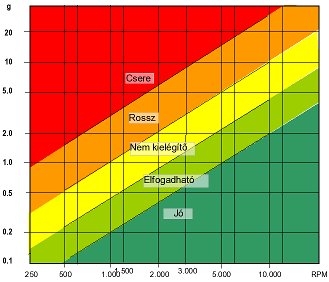 It should be noted that vibrations in the 2-20 kHz frequency range can also occur for other reasons (e.g., due to fluid cavitation), causing the bearing condition indicator value to be high without the bearing being damaged. The same applies when measuring on gear transmissions or equipment performing contact (frictional) mechanical machining, as these machines inherently produce vibrations between 10-20 kHz during operation.
A high bearing condition indicator value can also occur if the bearing is only overloaded (e.g., due to misalignment issues) or if the lubrication is inadequate. This should be verified by frequency analysis (spectrum analysis) based vibration measurements.
Machine Condition Monitoring with Trend Analysis
For organizing condition-based machine maintenance, the most valuable information is the rate of deterioration of machine condition, which can estimate when and what intervention needs to be performed to ensure that the machine operates without unexpected downtime (and unnecessary repairs) but also does not suffer major damages from existing minor faults until maintenance. To achieve this, the trend of machine vibrations (the broadband vibration velocity effective value and the high-frequency vibration acceleration value) must be prepared, where the rate of increase provides information on expected durations. The method for this will be the topic of our next article. Rahne Eric (PIM Ltd.) pim-ltd.com, machineryexpert.com
The content of the publication is protected by copyright, and its (even partial) use, electronic or printed re-publication is only permitted with the indication of the source and the author's name, as well as with the author's prior written permission. Infringement of copyright (Copyright) will have legal consequences.
Copyright © PIM Professzionális Ipari Méréstechnika Kft.
2026 | Minden jog fenntartva
Impresszum | Adatkezelés