


"Instead of firefighting and major repairs"
Condition-based maintenance with vibration diagnostics (II.)
Operators' demand for reliable yet cost-effective operation of machinery is increasing. This demand is fully met by the introduction of condition-based maintenance. The most suitable method for assessing the mechanical condition of machines during operation is vibration diagnostics. Vibration measurement-based machine diagnostics assist in organizing condition-based and reliability-based machine maintenance. The main idea is to estimate the deterioration of the examined machines, the expected service life of the machines (or their components), and the timing of necessary maintenance based on trends established from measurements performed more frequently. The goal is to ensure production with high reliability, without unexpected shutdowns, continuous quality assurance, and with minimal maintenance costs (avoiding unnecessary repairs and preventing major damages from minor unnoticed faults). In recent years, tools and technologies for assessing the condition of rotating machinery have significantly advanced. While not so long ago a screwdriver or a standing coin was the only widespread industrial "diagnostic tool," it is now undeniable that the application of modern machine diagnostics is essential for achieving and maintaining cost-effective production. When selecting diagnostic technology, various factors must be considered. Economic factors:
Production characteristics:
Technical aspects include:
The costs of imbalance
Unfortunately, it is still common to hear that diagnostic tools are expensive, and maintaining the personnel operating them is costly – therefore, introducing such technologies for modernizing maintenance is not worth it. With the following selected example, we aim to prove that reality is quite the opposite: the lack of organization in maintenance, neglecting the machine's condition is costly. In the example taken, we examined the effect of various maintenance strategies on the costs of eliminating faults arising from imbalance on a continuously operating climate ventilator in, for example, an electronics assembly hall. This technology falls into the non-critical category, with a maximum downtime of 5 hours, beyond which production losses occur. The costs in the table are provided without detailing the calculations. It is easy to see that with critical technologies, significantly higher losses, even bankruptcy, could be expected. Machine operation or maintenance in the "0" version is characterized by negligence, with faults noticed only when the equipment stops due to the motor burning out. Repairs include motor repair, shaft refurbishment, dual bearing replacement, and balancing. If machine operation (maintenance) is carried out according to category "A," there is no or irregular vibration measurement, hence faults are not noticed until the bearings completely fail, leading to shaft damage (bearing seat). Repairs: shaft refurbishment, dual bearing replacement, balancing. Machine operation and maintenance in category "B" are based on simple vibration measurement and trend monitoring. The fault is noticed, but by then, both bearings need replacement (the shaft is still intact). Repairs are limited to dual bearing replacement and balancing. Well-organized machine operation and maintenance, regular diagnostics, or installed vibration monitoring support in version "C." Faults are immediately noticed, and both bearings are still intact. Repair at this point only involves balancing. It should be noted that in the case of machine operation in the "C" category, at least one vibration diagnostic expert is required. Summary cost analysis table
| "0" machine downtime | "A" visual inspection | "B" vibration trend | "C" diagnostics | |
| Motor repair + removal and installation | 116,000 HUF | |||
| Shaft refurbishment + installation | 58,000 HUF | 58,000 HUF | ||
| Dual bearing replacement | 46,000 HUF | 46,000 HUF | 46,000 HUF | |
| Balancing | 40,000 HUF | 40,000 HUF | 40,000 HUF | 40,000 HUF |
| Downtime (50,000 HUF/hour) | 13×50,000 HUF | 9×50,000 HUF | 1×50,000 HUF | |
| Total cost | 910,000 HUF | 594,000 HUF | 136,000 HUF | 40,000 HUF |
Current equipment selection
Below, we review the range of portable instruments currently used for machine condition assessment.
.gif "Vibration meters, vibration level data collectors")
Digital vibration meters, vibration level data collectors (price range 150–600 thousand HUF, with software)
The most valuable information for organizing condition-based machine maintenance is the rate of deterioration of the machine's condition, based on which it can be estimated when and what intervention needs to be carried out to ensure that the machine operates without unexpected shutdowns (and unnecessary repairs) and does not suffer greater damage resulting from existing minor faults. For this purpose, machine vibrations need to be regularly measured, and the rate of their increase provides information about expected lifetimes. Simple handheld instruments rate the measured parameters (such as vibration velocity) with a single number. Such vibration meters are small in size (fit in a pocket) and very easy to operate. Most commonly, the effective value of vibration velocity is measured in the frequency range recommended by ISO 10816, 10–1000 Hz or 10–3200 Hz. The instruments are excellent at detecting imbalance, mechanical looseness, resonance, and misalignment. If the instrument is also capable of measuring vibration velocity according to ISO standards and high-frequency vibration acceleration (characteristic of rolling bearing condition), as well as the envelope curve, it can reveal not only the presence of alignment and balancing issues but also bearing faults and inadequate lubrication. Headphones are available for vibration meters that process signals from piezoelectric vibration sensors (with adjustable filters and amplifiers), making them usable as stethoscopes. Due to the large number of machines in many companies, it is no longer advisable to record vibration values "on paper with a pencil," then create graphs or transfer the data individually to a PC. Pocket-sized data collectors are available for such tasks, capable of measuring vibration velocity and high-frequency vibration acceleration, storing data from multiple machine vibrations (even as a measuring route), and transferring them to a PC. The accompanying PC software can not only create trends but also monitor limit values, generate various reports, and, like the PIM ProfiTrend software, log maintenance activities. With digital vibration level meters, 60% of machine faults can be detected in time. With regular use of vibration level data collectors and trend analysis, 70% of rotating machinery faults can be identified, making maintenance planning timely.
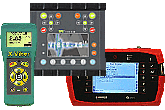
Vibration analyzers and data collectors (device 1–6 million HUF, software 300 thousand HUF–6 million HUF)
Vibration spectrum analysis is currently the most effective machine condition assessment tool (provided that the information it contains is interpreted with expertise), assuming that every machine or machine component can be characterized by resonance frequencies as a "rigid" body, and every machine fault results in vibrations of precisely determined frequencies based on the current machine speed. By analyzing recorded vibration signals, the "elementary" vibrations contained within become "visible," and their frequencies can be associated with machine components and faults based on the above. Through vibration spectrum analysis, machine settings and individual machine element faults can be precisely identified. This method is also capable of, for example, separately indicating damage to the inner or outer ring or cage of a bearing. By measuring the electrical parameters of electric motors, electrical faults (such as breakage of asynchronous motor rotor bars) can also be identified. Handheld machine expert instruments offer a cost-effective alternative to high-end diagnostic tools consisting of instruments and PC software. On the one hand, machine analyzer data collectors have basic features and capabilities, and on the other hand, they provide machine fault indications that were previously expected only from expert evaluation software running on a PC - so-called expert systems. The result is the immediate textual display of machine faults discovered based on measurements. With such a tool, even a trained but inexperienced machine operator can quickly receive information about the condition of the examined rotating machine to make decisions regarding maintenance organization. External diagnostics or analysis of vibration spectra by a specialist are not required for this. By using vibration analyzers or machine expert instruments, 85% of faults can be detected in time. With regular use of vibration analyzer data collectors and trend analysis (with appropriate maintenance technology frequency and organization), this ratio can statistically increase to 95%.
Quick Return on Investment
Below is a summarized table of the necessary instrument functions for various machine operation attitudes mentioned in the example, as well as the minimum expected investment amount. Vibration diagnostic technologies and their costs
| Vibration Velocity | Bearing Condition | Trend (on PC) | Vibration Data Collector | Spectrum Analysis | Balancing | Expert Instrument | Expert System | Machine Protection | Expected min. investment requirement | |
| „0” | 0 HUF | |||||||||
| „A” | x | 150,000 HUF | ||||||||
| x | x | 200,000 HUF | ||||||||
| „B” | x | x | x | 250,000 HUF | ||||||
| x | x | x | x | 500,000 HUF | ||||||
| x | x | x | 200,000 HUF/machine | |||||||
| „C” | x | x | x | x | x | 1,000,000 HUF | ||||
| x | x | x | x | x | 1,000,000 HUF | |||||
| x | x | x | x | x | x | 2,500,000 HUF | ||||
| x | x | x | x | x | x | x | 7,000,000 HUF | |||
| x | x | x | x | x | x | x | 1,000,000 HUF/machine |
* In case of machine operation of type "C," the employment of at least one vibration diagnostic expert is required. By comparing the tables, it is clearly visible that the minimal cost of any instrument purchase is practically recovered even in the case of non-critical processes by preventing just one or two breakdowns. In the long term, the profitability achievable through the application of individual methods (instrument levels) naturally strongly depends on the role the equipment plays in the technology. The extent of profit that can be extracted increases with the costlier technology (maintenance). The higher level of machine condition monitoring is justified. Rahne Eric (PIM Ltd.) pim-kft.hu, gepszakerto.hu
The content of this publication is protected by copyright. Any (even partial) use, electronic or printed re-publication is only permitted with the indication of the source and author's name, and with the author's prior written consent. Violation of copyright (Copyright) entails legal consequences.
Copyright © PIM Professzionális Ipari Méréstechnika Kft.
2026 | Minden jog fenntartva
Impresszum | Adatkezelés