


"Instead of firefighting and major repairs"
Condition-based maintenance with vibration diagnostics (I.)
As industrial producers increasingly utilize their production capacity, the application of maintenance systems capable of preventing unexpected failures causing production losses becomes more and more important. Significant successes can be achieved with planned preventive maintenance (commonly abbreviated as PPM) and the use of modern lubricants that are continuously evolving, but the risk factor remains too high. The disadvantage of PPM - the additional costs (losses) resulting from the unnecessary replacement of still good or even completely faultless components - justifies the need for other methods. Nowadays, the theoretical and practical development of vibration diagnostics (vibration monitoring, machine diagnostics, vibration analysis) enables significantly more efficient maintenance methods than before. Many domestic and foreign companies successfully implement maintenance organized based on regular vibration diagnostic evaluations under the names of condition-based or reliability-centered maintenance. The goal of such methods is to provide the operator (maintenance personnel) with timely information on the technical condition of machine components based on the measurement of machine vibration characteristics, as well as potential problems and failures. The advantage of preventing machine and component failures is clearly noticeable when considering the magnitude of unexpected machine downtime and the daily or weekly losses they can cause. In the intensified competitive environment of the industry, it is increasingly necessary to maintain the good condition of existing equipment. Not to mention that production is carried out with increasingly specialized machines, and it is becoming more difficult to quickly procure their specific components. Storing spare parts also requires space and capital. It seems advisable to prevent major and costly machine damages by promptly addressing minor faults. Maintenance organization methods Operation until shutdown (until machine failure)
We would like to say that this method is a thing of the past (it used to be very common), but unfortunately, many - especially smaller, capital-deficient - companies still operate their machines in this way: they keep running until they break down on their own. This naturally has serious consequences: production unexpectedly stops, in addition to the primary fault in the machine, usually severe consequences (secondary damages) also occur.
While this type of maintenance may seem inexpensive until a serious machine failure occurs, the operator pays multiple times when the serious machine failure happens: the repair is unplanned, so repair capacity is needed suddenly (possibly with an urgent surcharge), parts are needed (much more than if the initial faults were corrected, often with express delivery surcharges), there is a huge (long-term) production loss and incidental costs (overtime, late penalties, etc.). The more important a particular machine is for the operation (for example, entire production lines depend on it, it has a "vital" task), the less acceptable it is to apply maintenance of the "operation until shutdown" type. Due to the current and future drastic increase in the listed additional costs, it is advisable to apply a different - more economical - method even for non-critical machines. PPM, planned preventive maintenance In order to minimize the occurrence of unexpected machine failures, machines undergo preliminary repairs at planned intervals or after a certain number of operating hours (i.e., before a breakdown could occur). The basis for this is the manufacturer's specifications (e.g., oil change interval for cars), operational experience, or failure statistics based on the operation of multiple identical machines, or simply the maintenance "necessity" arising from seasonal operation. The positive aspect of this method is that it significantly reduces the number of unexpected failures and increases machine reliability. However, this is achieved at a great waste: even good machine parts are replaced, unnecessary repairs are carried out. Not to mention that after the installation and replacement of parts in good condition, the machine's condition is not always better than before: according to statistics, 10% of repairs are faulty. Moreover, after major repairs, faults need to be corrected in up to a quarter of the machines during restart! Overall, it can be said that the production profit gained from the increased reliability of machines is largely spent on unnecessary parts (and their inventory) and unnecessary repair labor. Nevertheless, there are still faults - not included in the regular maintenance schedule - that are not corrected in time and can even cause machine downtime. Machine condition-based maintenance
To eliminate the flaws of the PPM method, condition-based maintenance is suitable, which is based on the replacement of worn, aged, worn, or damaged components only through the assessment of machine condition, instead of time-based preventive repairs. This way, there is no unnecessary replacement of faultless parts due to unnecessary repairs, yet machine reliability can still be guaranteed. Furthermore, with regular condition assessments, maintenance can be planned in advance, the storage and procurement costs of necessary parts can be minimized, and labor costs can also be reduced.
A prerequisite for machine condition-based maintenance is the comprehensive (and accurate) - regular - inspection of machine conditions, as only this way can developing faults be filtered out before they lead to machine downtime or more severe secondary faults. Various technologies are available for machine assessment, such as vibration measurement and spectrum analysis (the most widespread and effective method), ultrasonic measurement and analysis, lubricant analysis, electric motor analysis, thermography, and many others, as well as combinations of the listed methods. The earlier machine faults are discovered and the degradation rate is more accurately estimated (based on multiple repeated measurements), the more effective this maintenance organization strategy is, the maintenance latest time can be planned, and the necessary parts can be predetermined. The result: high availability (continuous operation without unexpected shutdowns) with minimal maintenance costs.Goals and Benefits The long-term goal of introducing and maintaining condition-based maintenance is economic savings, which consist of two factors. Cost savings:
Revenue growth:
Additional benefits of condition-based maintenance:
Basic Concept of Vibration Diagnostics
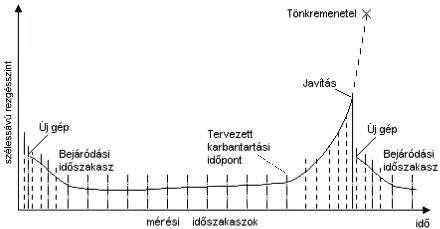
Every solid object is capable of vibrating in multiple directions at different frequencies. The largest displacements can be observed at the natural frequency of the object, as the object "resonates" at that frequency in a specific direction (hence the concept of resonance frequency). Naturally, no object starts vibrating on its own, external excitation – thus external force – is required. The greater this force, and its rate of change – in the case of alternating forces – matches the natural frequency of the object, the greater the vibrations the solid object performs in the direction determined by the force. In the case of rotating machines, the sources of vibrations are the inevitable alternating forces that occur during machine operation. These forces can never be completely eliminated, as they arise from, among other things, the normal alternating operation of the machine (e.g., reciprocating machines), the residual unbalance of rotating components, and periodic forces resulting from electrical drives (e.g., due to network harmonics). The effect of the forces present during operation on individual machine components can be imagined as each machine component being part of a spring-mass oscillating system. The rotating machine consists of numerous such oscillating systems, which are almost invariably interconnected and excite each other. Due to the resonance properties of solid objects, each machine element tends to follow the effect of the alternating force at its natural frequency. This applies not only to the moving components of the machine but also to all supporting elements. The frequency of vibrations measurable on the machine depends on the stiffness and mass of the mechanical elements and the associated amplitude. The smaller the machine element, the higher the frequency but the lower the amplitude of the vibrations it performs. The intensity of vibrations changes during the machine's or machine component(s)' lifespan due to changes in clearances, surfaces, and elasticity factors – wear and aging of the machine – as a consequence. The trend of these changes can be illustrated on a life curve (see our diagram below). The diagram shows that the vibration level is higher during the running-in period of a new machine element. For a run-in machine element, the vibration level remains approximately the same for a long time, and in the final stage of wear of the machine element, the vibration intensity increases (almost quadratically, or even faster).
Rahne Eric (PIM Ltd.) pim-ltd.com
machineryexpert.com
The content of this publication is protected by copyright. Any (even partial) use, electronic or printed re-publication is only permitted with the indication of the source and the author's name, and with the author's prior written permission. Infringement of copyright (Copyright) will result in legal consequences.
Copyright © PIM Professzionális Ipari Méréstechnika Kft.
2026 | Minden jog fenntartva
Impresszum | Adatkezelés