No further information available.



Home » Product Range » Infrared thermography, thermography » Selection Tips » Thermal Camera Measurement Characteristics
(Market supply professional overview)
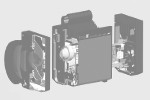
Thermal Camera Measurement Characteristics - Thermographic devices suitable for contactless temperature measurement (infrared cameras with thermographic capabilities) have undergone rapid development in recent years. Considering that these devices appeared just 50 years ago, they have now grown into one of the most well-known and versatile inspection tools, so it's no wonder that the market offers a wide variety of options (manufacturers, types). For a customer planning to purchase a thermal camera, the issue is no longer the lack of a suitable type according to their needs, but rather the overwhelming variety of choices available. Therefore, it is time to review the development and types of these instruments from a professional perspective, and organize the current offerings based on a few important technical parameters. Because: The measurement technology implemented in the cameras and the accessories available determine the device's application area, as well as the expected measurement accuracy and the achievable thermal image quality.
Matrix Thermal Camera Pixel Resolution - Overview of the Current Market Selection
Beyond the geometric resolution (i.e., the size of the surface "pixel" corresponding to a unique sensor) the image quality achievable with a thermal camera, or more precisely - the detail of the measurement - is determined by the number of pixels in the thermal camera. The reason for this is that for graphical (visual) recognition, a certain minimum number of pixels must fall on different parts of the object being measured - just as we are used to in digital photography. It is easy to understand that with more pixels, we can represent the object surface with greater detail or the same level of detail over a larger object surface in a single thermal image. If the number of pixels is low, many images need to be taken, and for the evaluation of contiguous objects and the preparation of reports, it often becomes necessary to montage the images (which is a very time-consuming task). This issue is not insignificant for thermal cameras. While in digital cameras we talk about resolutions of 10, 12, or even more than 20 megapixels (20 million pixels), in the case of matrix thermal cameras, the number of pixels is typically 320x240 (thus 76,800) or 384x288, and in the most professional thermal cameras, 640x480 (thus 307,200) or even 1024x768 (thus 786,432) pixels. There are also cameras with lower capabilities - a common type is 160x120 (thus only 19,200) pixels or even just 80x80 or 96x96 pixels, which consequently can only display smaller surfaces with acceptable detail, greatly limiting their area of use (or even making the thermal camera unusable). Thanks to the development of thermal camera sensors, cameras with an increasing number of pixels are being produced. Interestingly, the prices per pixel of the most professional cameras - with sensor matrices of 640x480 or 1024x768 pixels and frame rates of 50 or even 240 Hz - are the most favorable (even by an order of magnitude, compared to low-pixel - so-called Low-Cost - thermal cameras).
 Figure: Low-Cost thermal camera with 120x160 pixels / professional thermal camera with 2048x1536 pixels [source: PIM]
No further information available.
No downloadable files available.
Copyright © PIM Professzionális Ipari Méréstechnika Kft.
2026 | Minden jog fenntartva
Impresszum | Adatkezelés
Home » Product Range » Infrared thermography, thermography » Selection Tips » Thermal Camera Measurement Characteristics